CTX Feed’s Settings screen is where you set the plugin-wide defaults that every feed inherits. Rather than repeating the same choices on each feed, you configure them once here — caching, the Google product-category list, XML output formatting, diagnostics and logging, and which extra product attributes appear when you build a feed. Individual feeds can still override their own schedule and filters; everything else starts from these settings.
This overview walks through each section of the CTX Feed plugin settings so you know what every control does.
Where to find Settings
In your WordPress dashboard, open CTX Feed, then go to System → Settings.
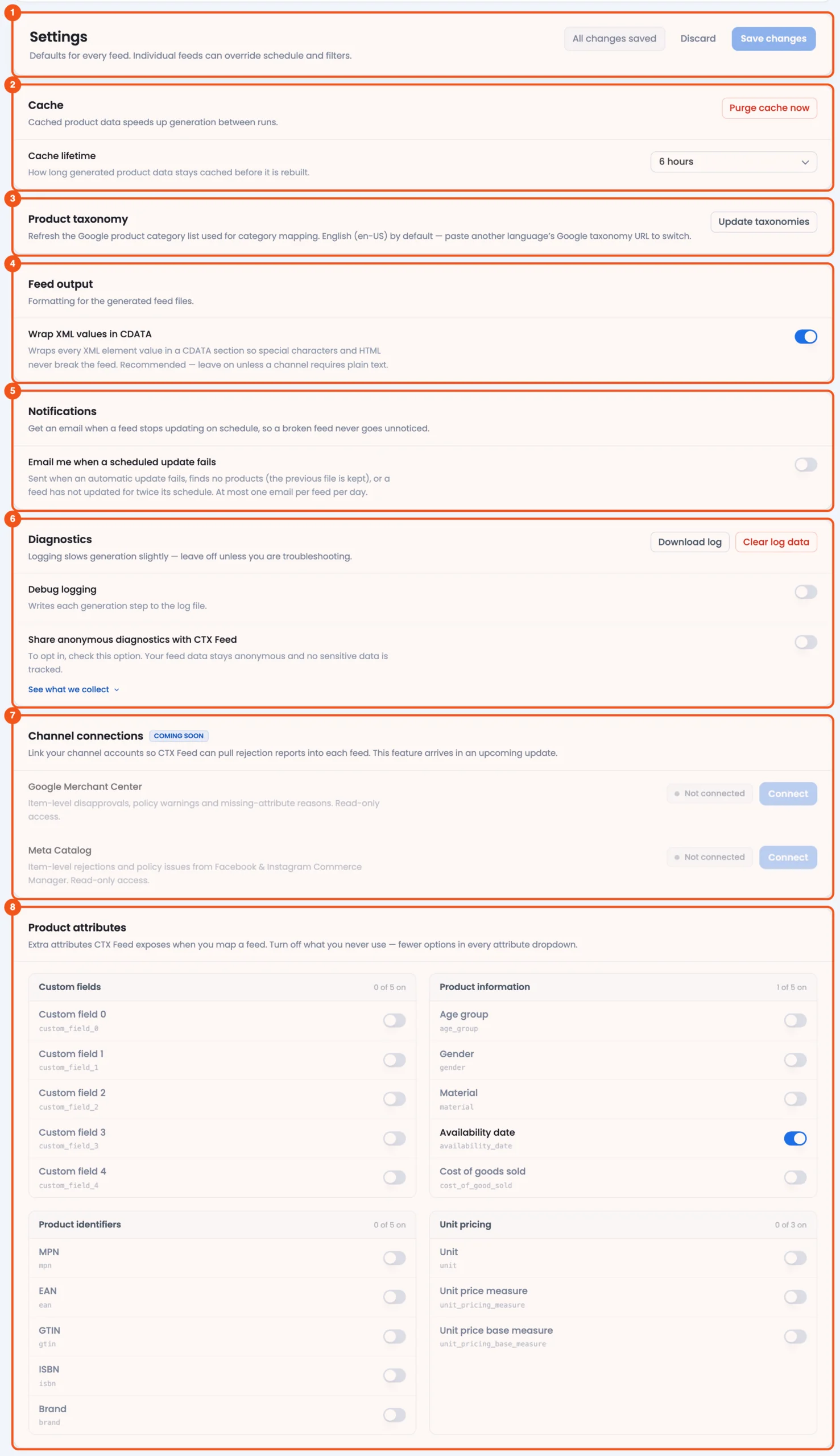
The screen is a stack of cards, top to bottom:
- Header — the page title and your save controls (see below).
- Cache — how long product data is cached, and a button to clear it.
- Product taxonomy — refresh the Google product-category list.
- Feed output — whether XML values are wrapped in CDATA.
- Notifications — an email when a feed stops updating on schedule.
- Diagnostics — debug logging and optional anonymous usage sharing.
- Channel connections — link merchant accounts (coming soon).
- Product attributes — choose which extra attributes appear when mapping a feed.
Saving your changes
CTX Feed settings do not save automatically. As you change any control, the save bar at the top keeps count of your unsaved edits.

- Unsaved-changes indicator — shows “All changes saved”, or how many edits are pending.
- Discard — drops your pending edits and restores the saved values.
- Save changes — writes your edits (only the fields you changed are sent).
Cache
Cached product data makes feed generation faster between runs.
- Cache lifetime — how long generated product data stays cached before it is rebuilt: 1 hour, 6 hours (the default), 12 hours, 24 hours, or Never expire.
- Purge cache now — clears the cache immediately (no need to click Save). Use it if a feed keeps showing outdated product information after you have edited products, then regenerate the feed. It also refreshes the feed editor’s attribute picker (for example a newly added custom field under Custom Fields & Post Metas), and from 8.0.25 it clears the in-memory copy on sites that use Redis or Memcached as well.
Product taxonomy
Update taxonomies refreshes the Google product-category list used for category mapping. It uses the English (en-US) list by default; to switch languages, click Update taxonomies and, in the Update product taxonomy dialog, paste that language’s Google taxonomy file URL into Taxonomy file URL (it starts filled with the en-US address), then click Update.
Feed output
Wrap XML values in CDATA — on by default. Every XML element value is wrapped in a CDATA section so special characters and HTML never break the feed. Leave it on unless a channel requires plain text; when it is off, CTX Feed wraps only the values that contain &, < or >. See Configure XML feed.
Notifications
Email me when a scheduled update fails — off by default, and part of CTX Feed Pro. When it is on, CTX Feed emails you when a feed’s automatic update:
- fails;
- finds no products, so the previous feed file is kept;
- has not run for twice its schedule (for example, an hourly feed that has not updated for 2 hours), which usually means the site’s scheduled tasks are not running.
You get at most one email per feed per day. Send to takes one or more addresses separated by commas; leave it empty to use the site admin email. Manual runs never send an email, because you see the result on screen. Click Save changes after changing either control.
Diagnostics
Tools for troubleshooting a feed:
- Debug logging — off by default. When on, CTX Feed writes each generation step to a log file. It slows generation slightly, so leave it off unless you are chasing a problem. See how to enable debug mode and download logs.
- Download log / Clear log data — download the current log to share with support, or wipe it. Both act immediately, without Save.
- Share anonymous diagnostics with CTX Feed — an optional opt-in, off by default, that helps improve the plugin. Click See what we collect to review exactly what is sent before you opt in.
Channel connections (coming soon)
A future update will let you link your Google Merchant Center and Meta Catalog accounts so CTX Feed can pull item-level rejection reports into each feed. The section is visible but disabled until that arrives.
Product attributes
This card controls which extra attributes CTX Feed offers in the attribute dropdown when you build or map a feed. Turning off the ones you never use keeps those dropdowns short and focused. Each attribute has its own on/off toggle, grouped into four sets:
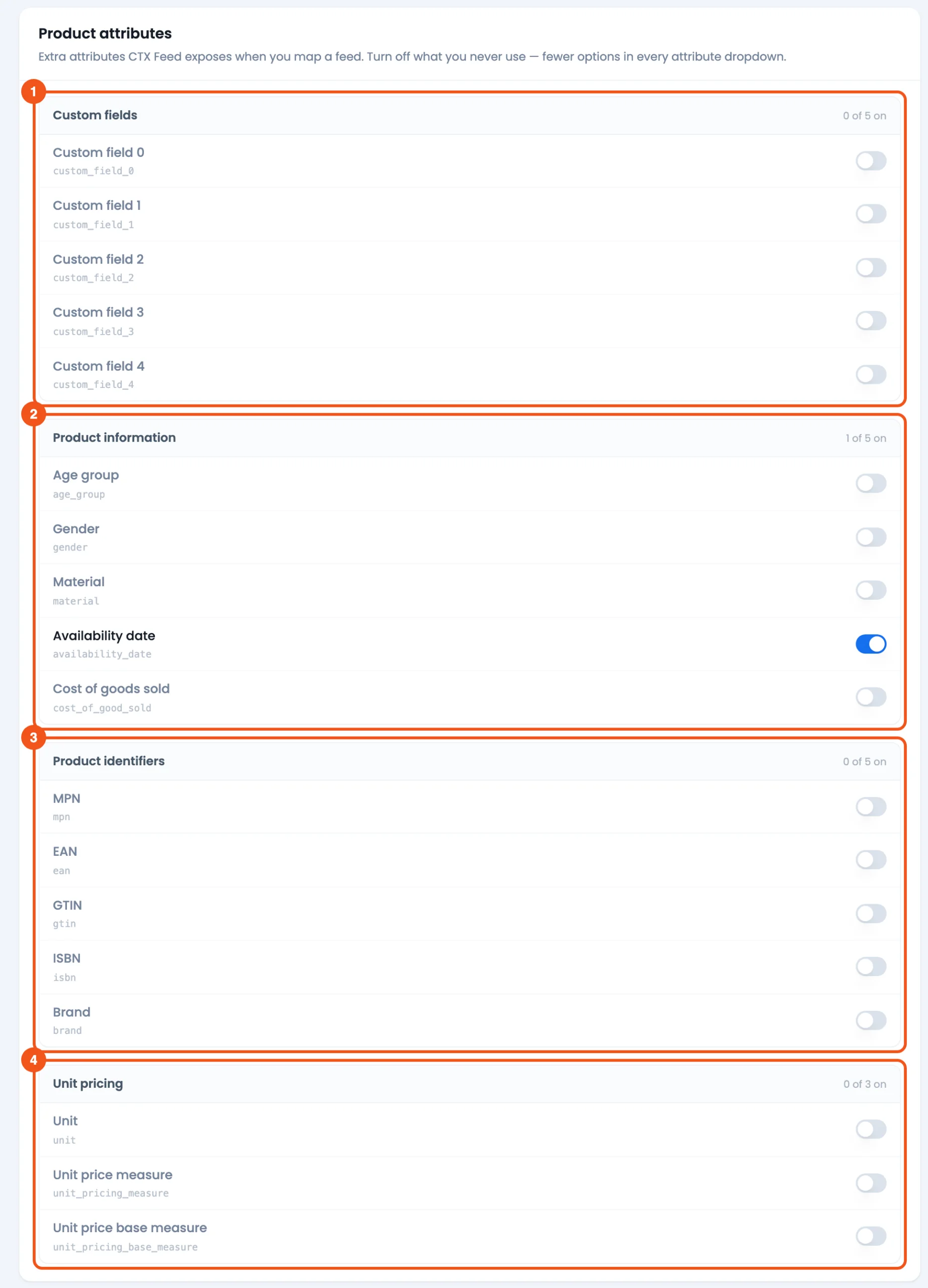
- Custom fields — Custom field 0 through 4.
- Product information — age group, gender, material, availability date, and cost of goods sold.
- Product identifiers — MPN, EAN, GTIN, ISBN, and Brand.
- Unit pricing — unit, unit price measure, and unit price base measure.
Each group shows how many of its attributes are on (for example 1 of 5 on); only Availability date is on by default. Save, then the change shows in a feed’s attribute dropdown — if it does not appear straight away, use Purge cache now.
Related guides
- Manage Feeds
- How to enable debug mode and download logs
- How to set up cron for automatic feed updates
