A WooCommerce variable product — a t-shirt in several sizes and colors, for example — is really a parent product with a set of child variations, each with its own SKU, price, and stock. Shopping channels want to advertise those individual variants, not the abstract parent. CTX Feed’s Include variations setting decides exactly what reaches the feed: every variation as its own listing, only the parent, both, or a single representative variant. This guide explains each mode and when to use it. All eight modes are part of the free plugin.
Where to set it
Include variations lives in the Feed settings card on the Make Feed screen:
- Open CTX Feed → Make Feed (or edit a feed from Manage Feeds).
- In Feed settings, find the Include variations dropdown (its hint reads “How variable products are exported”).
- Choose the mode that fits your channel (the options are explained below).
- Finish the rest of the feed, then click Save & generate.
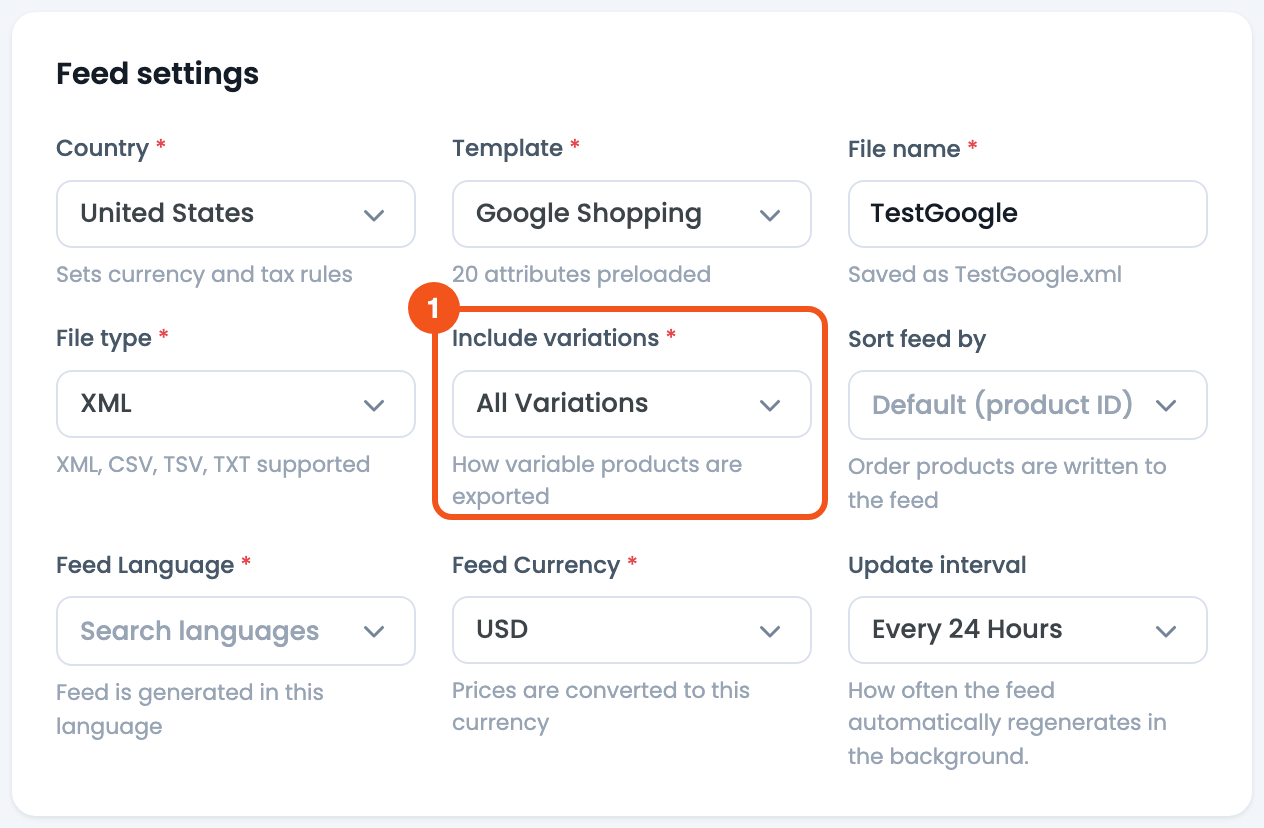
- Include variations — how variable products are exported (the setting this guide covers).
New feeds default to All Variations, which is what most advertising channels expect. A feed saved with the field blank is treated as All Variations too.
The variation modes
The Include variations dropdown offers eight choices:
- All Variations — each variation becomes its own row in the feed, carrying its own SKU, price, stock, and attribute values (size, color, and so on). The parent variable product is replaced by its children. This is the standard choice for Google Shopping and Meta, where each buyable variant needs its own listing.
- Variable Products (Parent) — only the parent variable product is written, as a single row. Its price is derived from the variations (see the strategy selects below). Use this when a channel wants one entry per product family rather than per variant.
- Default Variation — exports the one variation that matches the product’s default attributes in WooCommerce, as a single representative row.
- Cheapest Variation — exports the single lowest-priced variation (on a tie, the first one wins).
- Expensive Variation — exports the single highest-priced variation.
- First Variation — exports the first variation in the product’s variation list.
- Last Variation — exports the last variation in the list.
- Variable + Variations — the parent row and every variation row are exported, the parent first and then its variations. Use this only when a channel genuinely wants both the group entry and the individual variants.
The single-variation modes (Default, Cheapest, Expensive, First, Last) are handy when a channel or marketplace only allows one entry per product but you still want a real, buyable variant with a concrete price and SKU rather than the parent’s derived range. If no variation can be picked (for example, Default Variation on a product with no default attributes set), the parent row is written instead.
Price and quantity for the parent row
When you export the parent — that is, when Include variations is set to Variable Products (Parent) or Variable + Variations — the parent has no price or stock of its own, so CTX Feed derives them. Two extra selects appear in Feed settings:
- Variable price — which variation price the parent row reports: First Variation Price (the default), Max Variation Price, or Min Variation Price.
- Variable quantity — which variation stock the parent row reports: First Variation Quantity (the default), Max Variation Quantity, Min Variation Quantity, or Sum of Variation Quantity.
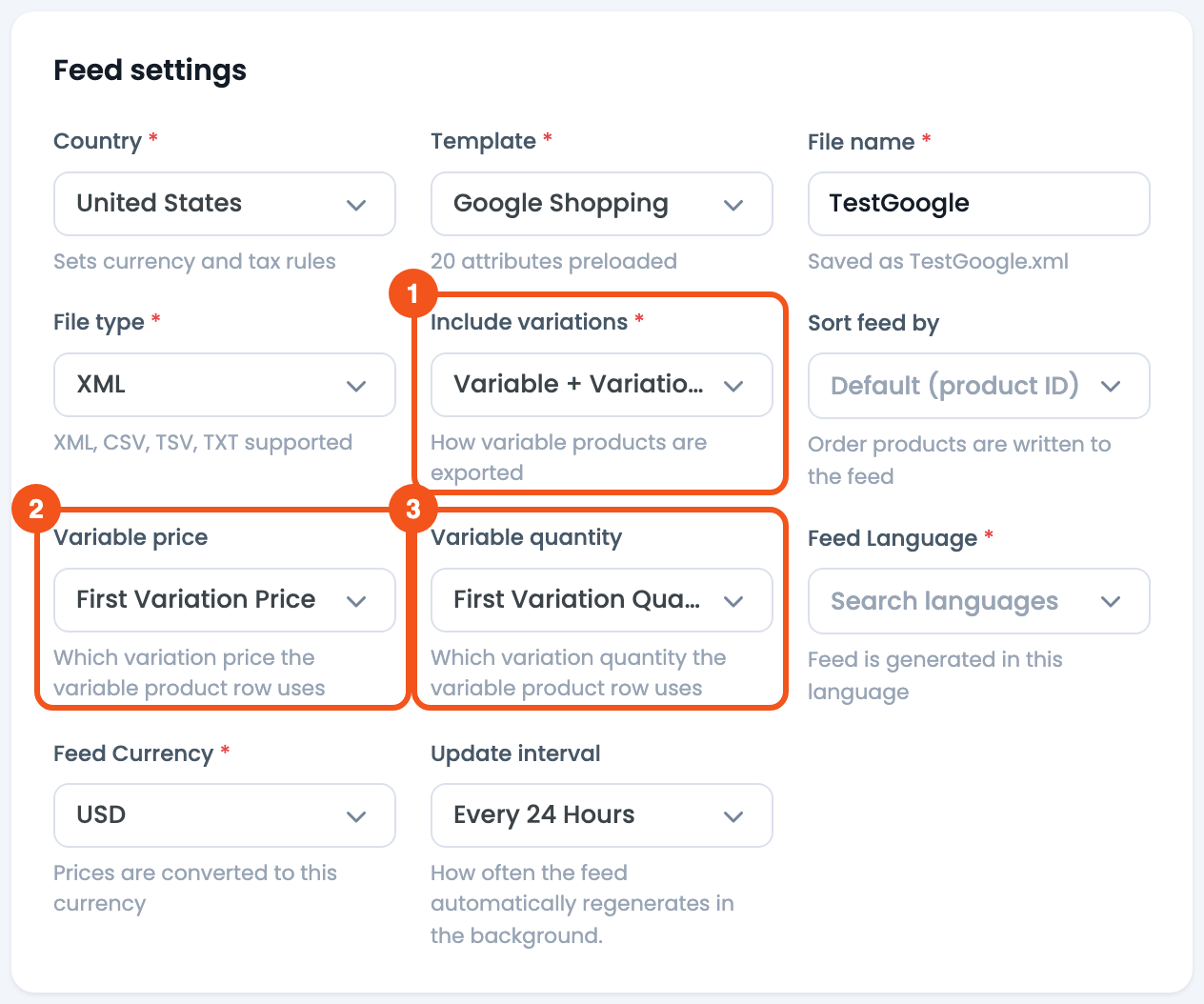
- Include variations — set to a mode that exports the parent.
- Variable price — the price the parent row reports.
- Variable quantity — the stock the parent row reports.
These selects are hidden for the other modes because there is no parent row to fill.
Grouping variants on the channel
When you send All Variations, channels need a way to know which rows belong to the same product. That is what the item_group_id field is for, on both Google and Meta. CTX Feed fills it automatically with the Parent Id [Group Id] attribute: a variation reports its parent product’s ID, and any other product reports its own ID, so all variants of one product share a value and cluster together. The channel then shows them as selectable options (size/color) under a single product. The Google and Meta templates already map this row for you.
Each variation row should also carry the variant-defining attributes — size, color, material, pattern — so the channel can build the option picker. Map those on the Config tab from the matching product attribute.

- The
item_group_idrow, mapped to Parent Id [Group Id]. Add the size, color, material and pattern rows below it with the + button.
Pulling parent details into variations
Variations frequently lack their own description, brand, or category — those live on the parent. For most fields CTX Feed automatically falls back to the parent product’s value when a variation’s own value is empty, so your variation rows still carry the full description and shared details. Two kinds of field never fall back: sale-price fields (a variation that isn’t on sale must not borrow the parent’s sale) and the image gallery fields (a variation ships only its own gallery images — see Configure Product Images Into Feed). For a deeper look, and for forcing a value to always come from the parent, see Add Variable Product Info to Variations.
Troubleshooting
- Only parent products appear in the feed. Include variations is set to Variable Products (Parent). Switch it to All Variations and regenerate.
- Variations are missing size/color in the feed. Map the variation attributes (size, color, etc.) on the Config tab; without those rows the channel can’t tell variants apart.
- The channel isn’t grouping variants together. Add or fix the item_group_id row so every variation of a product shares one group value.
- A variation has no price. Confirm the variation has a price set in WooCommerce. A variation without a price is still written to the feed, but with an empty price, and the channel will reject that item.
- A Google product review feed lists only parents. That’s expected: review feeds always use the parent product, whatever Include variations is set to.
- You changed variations but the feed is unchanged. Run Clear Cache on the Manage Feeds screen, then regenerate the feed.
Related guides
- Add Variable Product Info to Variations
- Configure Product Price
- Configure Product Images Into Feed
- Configure a CSV or TXT Feed
