Getting the right category into your product feed is one of the most important parts of setting a feed up. Shopping channels use it to file each product in the correct part of their own catalog, and a wrong or missing category is one of the most common reasons items are disapproved. This guide explains the two kinds of “category” a feed carries, and shows you exactly where in CTX Feed to configure each one — whether you want a single fixed category for the whole feed or a precise per-category match.
Two kinds of category in a feed
It helps to keep these separate, because most channels want both:
- Your store category (the category path). These are the WooCommerce categories your product already lives in — for example Clothing > T-Shirts. In a Google or Meta feed this becomes the
product_typevalue. It is free-text and comes straight from your store, so no matching work is needed. - The merchant / Google product category. This is the channel’s own fixed taxonomy — Google publishes a numbered list (for example 1604 — Apparel & Accessories > Clothing), and Facebook, Pinterest, Bing, Snapchat, TikTok and several others have their own lists, which CTX Feed ships for you. In a Google feed this is the
google_product_categoryvalue. Because it is the channel’s list, not yours, you have to tell CTX Feed which channel category each store category corresponds to.
Where feed attributes are configured
Every category value is set in the same place: the attribute table on the feed’s Config tab.
- In your WordPress dashboard, open CTX Feed → Make feed (or edit an existing feed from Manage feeds).
- In Feed settings, pick your Country, Template (the channel), File name, and File type. Choosing the template loads that channel’s default attribute list.
- Open the Config tab. Each row maps one Channel attribute (the field the channel expects) to a Source (Attribute or Text) and a Value.

- The product_type row — your store category path, from Product Category [Category Path].
- The google_product_category row — the channel’s own category, here from a saved Category Mapping set (Method 2 below).
The rest of this guide fills in the category rows.
Add your store category path
To send the WooCommerce category tree the product belongs to:
- On the Config tab, find or add the channel attribute that should carry it — for Google and most channels this is product_type.
- Set Source to Attribute.
- In Value, open the Primary Attributes group and choose one of:
- Product Category [Category Path] — the categories ticked on the product, joined with
>. Only the categories you actually ticked are listed, so a product ticked in Clothing and T-Shirts gives Clothing > T-Shirts, while one ticked only in T-Shirts gives just T-Shirts. - Product Full Category [Category Full Path] — the full path from the top level down, with every ancestor added for you (Clothing > T-Shirts even if only T-Shirts is ticked). If the product is in several categories, the longest path is used. Pick it when you want every level even for products ticked only in a sub-category.
- Parent Category / Child Category — a single category name, when the channel wants only one. With several categories ticked, Parent Category returns the one created first in your store and Child Category the one created last; they don’t look at the tree. A product with no category reports Uncategorized.
- Product Category [Category Path] — the categories ticked on the product, joined with
This value is generated per product from your store, so once the row is set there is nothing else to maintain.
Add the Google (merchant) product category
You have two ways to fill the google_product_category channel attribute, depending on whether one category fits the whole feed or you need per-category precision.
Method 1 — one fixed category for the whole feed
Use this when every product in the feed belongs to the same channel category (for example a feed that only contains coffee mugs).
- On the Config tab, set the Channel attribute to google_product_category.
- Set Source to Text.
- In Value, type the channel category. Google accepts either the numeric ID (for example
1604) or the full path (Apparel & Accessories > Clothing); the ID is the safer choice. Every product in the feed then reports that same category.
This is quick, but it applies one value to all products — so it only suits single-category feeds.
Method 2 — map each store category (recommended)
When your feed contains products from several categories, map each store category to its channel category once, then reuse that map. This is what Category Mapping is for.
- Go to CTX Feed → Category mapping and create a mapping set: name it, choose the Channel taxonomy (the same channel as your feed), and match each store category to a channel category. To give a whole branch the same value, use the copy button on a parent row (its tooltip reads “Copy this mapping onto its sub-categories”). See Map store category to merchant category for the full walkthrough.
- Back on the feed’s Config tab, set the Channel attribute to google_product_category.
- Set Source to Attribute.
- In Value, open the Category Mapping group and select the mapping set you just saved.
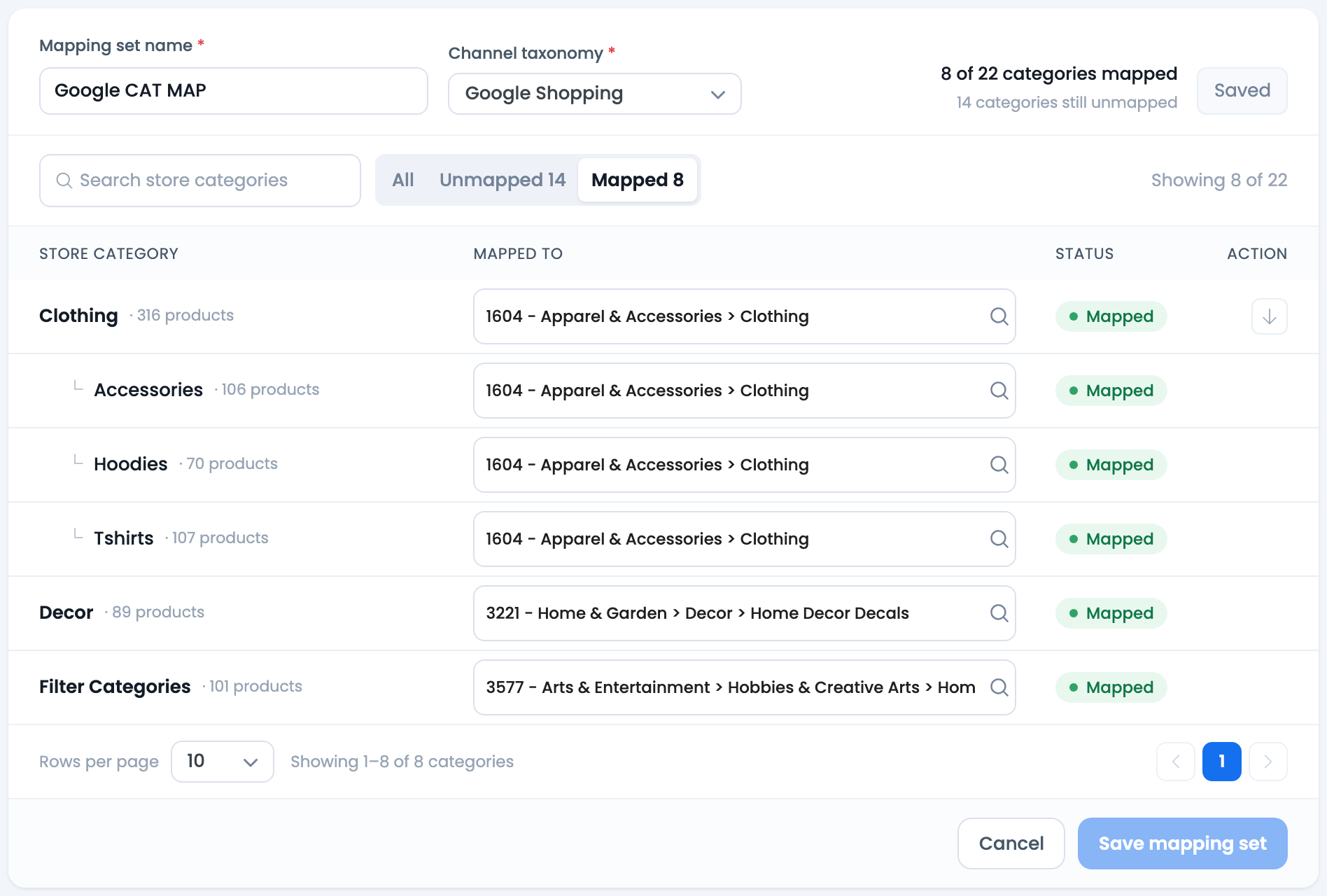
Now each product reports the channel category that its own store category is mapped to — the correct, per-product result Google and other channels expect. If a product is in several mapped categories, the deepest one wins. A category left blank in the set is simply skipped, and a variation uses its parent product’s categories.
Save and generate
- Click Save & generate. CTX Feed writes the feed file with your category values filled in.
- On Manage feeds, copy the Feed URL and confirm the category fields look right — either open the file in a new tab or download it.
Troubleshooting
- The category column is empty. Check that the row’s Source matches the value: Text for a typed category, Attribute for a store attribute or a mapping set. An Attribute row pointing at a store category the product does not belong to resolves to blank.
- Products rejected for “incorrect category”. Google validates
google_product_categoryagainst its published taxonomy. Make sure your mapping set uses current channel categories — refresh Google’s list from CTX Feed → Settings → Product taxonomy → Update taxonomies if it looks out of date. - A mapping set is missing from the Value dropdown. Every saved set appears in the Category Mapping group, whatever its channel. Confirm the set was saved on the Category mapping page, then reload the Make Feed screen.
- Only one category level shows. Use Product Full Category [Category Full Path] to send every level of the path; Product Category lists only the categories ticked on the product, and Parent Category / Child Category send a single name.
Related guides
- Map store category to merchant category
- Category mapping in a multilingual store
- Configure product price
- Configure product images into feed
