%22%2F%3E%0A%3Cpath%20d%3D%22M59.8894%2016.6974C60.1689%2016.9331%2060.5416%2017.1216%2060.9142%2017.0745C61.5664%2017.0273%2061.8925%2016.6031%2061.6596%2015.7547C61.5198%2014.4349%2061.4267%2013.1623%2061.2869%2011.8425C61.1006%209.72149%2060.8211%207.55331%2060.5881%205.38512L60.1689%201.70863C60.0757%200.81307%2059.6099%200.294591%2058.7713%200.106053C58.4918%20-0.0353509%2058.2123%20-0.0353509%2057.9328%200.106053C57.7931%200.106053%2057.6999%200.106053%2057.6067%200.153187C56.5353%200.483129%2055.4172%200.81307%2054.3458%201.19015C53.5073%201.47295%2052.6222%201.75576%2051.7371%202.03857C50.2929%202.50991%2048.8488%203.02839%2047.4047%203.49974C46.4264%203.82967%2045.4016%204.1596%2044.3768%204.48952L44.3767%204.48956C43.6313%204.72523%2043.3518%205.24371%2043.6313%205.85646C43.7711%206.13927%2044.004%206.32781%2044.2369%206.46921C44.7028%206.79915%2045.2152%207.08196%2045.6811%207.4119C45.8674%207.55331%2046.0537%207.69471%2045.8208%208.02465C45.7276%208.21319%2045.5879%208.35459%2045.4481%208.54313L45.355%208.73167L44.5164%2010.0986L43.9108%2010.9941L43.3052%2011.8897L43.2121%2011.9839L42.1406%2013.5865L44.5867%2019.8706C45.5713%2022.1447%2048.6357%2026.5713%2052.552%2023.6277L53.9265%2022.2593L54.3458%2021.5523C54.3924%2021.458%2054.4856%2021.3637%2054.5321%2021.2694L54.5787%2021.2223C55.2309%2020.1854%2055.883%2019.1956%2056.5352%2018.2059L56.5353%2018.2057C57.0477%2017.4044%2057.5601%2016.6503%2058.0726%2015.849C58.2123%2015.6604%2058.3055%2015.6133%2058.4918%2015.7076C58.9577%2016.0375%2059.4235%2016.4146%2059.8894%2016.6974Z%22%20fill%3D%22%233D89D0%22%2F%3E%0A%3Cpath%20d%3D%22M28.0259%2022.0232C27.9793%2022.0703%2027.9793%2022.1175%2027.9327%2022.1646C27.9793%2022.1175%2028.0259%2022.0703%2028.0259%2022.0232Z%22%20fill%3D%22url(%23paint1_linear)%22%2F%3E%0A%3Cpath%20d%3D%22M53.9265%2022.3064C53.7402%2022.5892%2053.5538%2022.872%2053.3675%2023.202C53.0414%2023.7204%2052.7153%2024.1918%2052.3892%2024.7103C51.3178%2026.4071%2050.1531%2027.9625%2048.4295%2029.0938C46.9388%2030.0365%2045.4015%2030.6021%2043.6779%2030.8849C42.1872%2031.1206%2040.7896%2030.9791%2039.3921%2030.5549C37.6219%2030.0365%2036.038%2029.1409%2034.687%2027.8211C33.7088%2026.8784%2032.9634%2025.7944%2032.3578%2024.616C32.0317%2023.9561%2031.7988%2023.2491%2031.4727%2022.5421C31.0534%2021.5522%2030.1683%2019.2427%2030.1218%2019.1012C30.0752%2019.0541%2030.0752%2018.9598%2030.0286%2018.9127C29.9354%2018.7242%2029.8422%2018.5828%2029.7957%2018.3942C29.6559%2018.0172%2029.4696%2017.6401%2029.3298%2017.2159C29.2366%2017.0273%2029.1901%2016.8388%2029.0969%2016.6503C28.9571%2016.3674%2028.864%2016.0846%2028.7242%2015.7547C28.5845%2015.3776%2028.4447%2015.0005%2028.2584%2014.6235C28.1652%2014.3407%2028.0254%2014.0579%2027.9323%2013.775C27.9323%2013.7279%2027.9323%2013.7279%2027.8857%2013.6808C27.7925%2013.4922%2027.7459%2013.3037%2027.6528%2013.1152C27.4664%2012.5967%2027.2335%2012.1253%2027.0006%2011.6069C27.0006%2011.5597%2026.954%2011.5126%2026.9074%2011.4655C26.8142%2011.2769%2026.7211%2011.1355%2026.5813%2010.947C26.5347%2010.8998%2026.4882%2010.8527%2026.4882%2010.8056C26.4416%2010.7584%2026.395%2010.7113%2026.395%2010.6642C26.3484%2010.617%2026.3018%2010.5699%2026.2552%2010.5228C26.2086%2010.4756%2026.2086%2010.4285%2026.1621%2010.4285L26.1155%2010.3814C26.0689%2010.3342%2026.0223%2010.2871%2026.0223%2010.2871C25.9291%2010.1928%2025.8826%2010.1457%2025.7894%2010.0514C25.7428%2010.0043%2025.6962%209.95715%2025.6496%209.95715C25.603%209.91002%2025.5565%209.91002%2025.5099%209.86288C25.4167%209.81575%2025.3701%209.76861%2025.277%209.67435C25.2304%209.62721%2025.1838%209.62721%2025.1372%209.58008C25.0906%209.53294%2025.044%209.53294%2024.9974%209.48581C24.9509%209.48581%2024.9043%209.43867%2024.9043%209.43867C24.8577%209.39154%2024.8111%209.39154%2024.7645%209.3444C24.7179%209.3444%2024.7179%209.29727%2024.6714%209.29727C24.5782%209.25014%2024.485%209.203%2024.3918%209.15587C22.9943%208.59025%2021.1775%208.77879%2020.1992%209.10873C19.2675%209.43867%2018.2893%2010.3342%2018.2427%2010.4285C18.6619%209.72148%2019.0812%208.96733%2019.547%208.26031C20.1526%207.36475%2020.7117%206.4692%2021.3638%205.62078C22.3887%204.63095%2023.4602%203.78253%2024.6714%203.07551C27.0006%201.75575%2029.4696%201.52007%2032.0317%201.89715C33.3361%202.08569%2034.5939%202.60417%2035.7585%203.35832C36.9231%204.06534%2037.9014%204.96089%2038.7399%206.04499C39.2989%206.79914%2039.8114%207.60043%2040.1374%208.49598C40.6033%209.67435%2041.1623%2010.8056%2041.5816%2011.9839C41.7679%2012.5496%2042.0008%2013.068%2042.2338%2013.6336C42.2338%2013.6336%2042.2338%2013.6336%2042.2338%2013.6808V13.7279L45.0288%2019.8554C45.4015%2020.8452%2045.9139%2021.6465%2046.7059%2022.3535C47.2183%2022.872%2047.8705%2023.1548%2048.5227%2023.3905C48.5693%2023.3905%2048.6158%2023.4376%2048.6624%2023.4376C49.7805%2023.7676%2051.2246%2023.3905%2052.3426%2023.0134C53.088%2022.6835%2053.6936%2022.4007%2053.9265%2022.3064Z%22%20fill%3D%22url(%23paint2_linear)%22%2F%3E%0A%3Cpath%20d%3D%22M28.0255%2022.0238C27.9789%2022.0709%2027.9789%2022.118%2027.9324%2022.1652C27.9324%2022.1652%2027.9324%2022.1652%2027.9324%2022.2123C27.7926%2022.448%2027.6063%2022.6836%2027.4665%2022.9664C25.8826%2025.8416%2024.4385%2028.1512%2021.6434%2029.6595C19.3142%2030.9793%2016.8452%2031.215%2014.2831%2030.8379C14.1433%2030.8379%2014.0501%2030.7908%2013.9104%2030.7908C12.7458%2030.6022%2011.5812%2030.0838%2010.4165%2029.2825C8.78607%2028.1512%207.52829%2026.5958%206.64318%2024.8047L6.17733%2023.9091L5.01272%2021.5524L0.726927%2012.6911C0.447419%2012.0784%200.214496%2011.4656%200.121327%2010.8529C-0.437689%207.8834%200.95985%204.77252%203.80151%203.35849C5.43198%202.51007%207.24878%202.4158%208.87924%202.93428C10.6029%203.45276%2012.1402%204.67825%2013.0253%206.46937L13.1184%206.6579L14.7489%209.95732C14.7955%2010.0516%2014.7955%2010.1459%2014.8421%2010.2401C15.075%2010.8529%2015.8204%2012.4083%2016.426%2013.5867C16.4725%2013.6809%2016.5191%2013.7752%2016.5657%2013.8223C16.6123%2013.9638%2016.7055%2014.1052%2016.752%2014.1994C16.7986%2014.2937%2016.8452%2014.3408%2016.8452%2014.4351C16.8452%2014.4822%2016.8918%2014.4822%2016.8918%2014.5294C16.9384%2014.5765%2016.9384%2014.6708%2016.985%2014.7179C16.985%2014.765%2017.0316%2014.765%2017.0316%2014.8122C17.0316%2014.8593%2017.0781%2014.8593%2017.0781%2014.9064C17.0781%2014.9536%2017.1247%2015.0007%2017.1247%2015.0478C17.1247%2015.095%2017.1713%2015.095%2017.1713%2015.1421C17.3111%2015.4249%2017.4042%2015.7549%2017.544%2016.0377C17.6372%2016.2262%2017.6837%2016.4147%2017.7769%2016.6504C17.9632%2017.1689%2018.1962%2017.6402%2018.3825%2018.1587C18.5223%2018.4415%2018.6154%2018.7715%2018.7552%2019.0543C18.8018%2019.1485%2018.8484%2019.29%2018.8949%2019.3842C18.9881%2019.5728%2019.0347%2019.7613%2019.1279%2019.9498C19.3608%2020.5154%2019.5937%2021.0811%2019.9664%2021.5995C20.1993%2021.8823%2020.3857%2022.1652%2020.6652%2022.4008C22.3888%2023.9563%2024.9975%2023.862%2028.0255%2022.0238Z%22%20fill%3D%22url(%23paint3_linear)%22%2F%3E%0A%3Cpath%20d%3D%22M68.0888%2024.8694L68%207.88696H71.9963L71.8187%2018.4448L76.8806%207.88696H80.6548L81.3209%2018.3999L85.5392%207.88696H89.713L82.4754%2024.8694H78.1683L77.5466%2013.9072L72.3959%2024.8694H68.0888Z%22%20fill%3D%22%230D5293%22%2F%3E%0A%3Cpath%20d%3D%22M92.7771%2025.1385C89.2693%2025.1385%2086.7383%2022.6675%2086.7383%2019.2081C86.7383%2015.3893%2089.8021%2012.1545%2093.4431%2012.1545C96.6402%2012.1545%2098.8603%2014.4458%2098.8603%2017.7704C98.8603%2018.5342%2098.8159%2019.1182%2098.7271%2019.6124H90.4237C90.6457%2021.0501%2091.7114%2022.0385%2093.2211%2022.0385C94.1536%2022.0385%2094.9528%2021.724%2095.5301%2021.095L97.617%2023.4762C96.0185%2024.6443%2094.5976%2025.1385%2092.7771%2025.1385ZM90.6457%2017.411H95.4857C95.3081%2016.0632%2094.4644%2015.2545%2093.2211%2015.2545C92.0666%2015.2096%2091.0898%2016.0632%2090.6457%2017.411Z%22%20fill%3D%22%230D5293%22%2F%3E%0A%3Cpath%20d%3D%22M105.965%2024.9589C104.411%2024.9589%20103.167%2024.24%20102.368%2022.8473L101.924%2024.869H98.1499L101.791%207.52717L105.698%206.89819L104.322%2013.5923C105.166%2012.7836%20106.32%2012.2894%20107.519%2012.2894C110.139%2012.2894%20112.181%2014.8054%20112.181%2018.0401C112.226%2021.814%20109.428%2024.9589%20105.965%2024.9589ZM103.789%2016.3778L102.945%2020.4212C103.478%2021.185%20104.366%2021.6792%20105.388%2021.6792C107.208%2021.6792%20108.54%2020.2415%20108.54%2018.3097C108.54%2016.6474%20107.43%2015.4793%20105.92%2015.4793C105.077%2015.4793%20104.411%2015.7937%20103.789%2016.3778Z%22%20fill%3D%22%230D5293%22%2F%3E%0A%3Cpath%20d%3D%22M120.44%207.88696H125.058L127.899%2024.8694H123.725L123.193%2020.8259H117.154L114.978%2024.8694H110.582L120.44%207.88696ZM122.704%2017.5912L121.949%2011.9304L118.886%2017.5463H122.704V17.5912Z%22%20fill%3D%22%230D5293%22%2F%3E%0A%3Cpath%20d%3D%22M131.23%2012.3347H135.004L134.782%2013.5927C135.626%2012.7391%20136.736%2012.2449%20137.935%2012.2449C140.555%2012.2449%20142.597%2014.7608%20142.597%2017.9955C142.597%2021.8143%20139.8%2024.9592%20136.336%2024.9592C134.782%2024.9592%20133.539%2024.2853%20132.828%2022.9824L131.274%2030.0809H127.456L131.23%2012.3347ZM134.205%2016.3332L133.317%2020.5114C133.85%2021.2303%20134.738%2021.6796%20135.715%2021.6796C137.535%2021.6796%20138.867%2020.2419%20138.867%2018.31C138.867%2016.6477%20137.757%2015.4796%20136.247%2015.4796C135.493%2015.4796%20134.827%2015.7492%20134.205%2016.3332Z%22%20fill%3D%22%230D5293%22%2F%3E%0A%3Cpath%20d%3D%22M144.595%2012.3347H148.369L148.147%2013.5927C148.99%2012.7391%20150.101%2012.2449%20151.299%2012.2449C153.919%2012.2449%20155.962%2014.7608%20155.962%2017.9955C155.962%2021.8143%20153.164%2024.9592%20149.701%2024.9592C148.147%2024.9592%20146.904%2024.2853%20146.193%2022.9824L144.683%2030.0809H140.865L144.595%2012.3347ZM147.57%2016.3332L146.682%2020.5114C147.214%2021.2303%20148.102%2021.6796%20149.079%2021.6796C150.9%2021.6796%20152.232%2020.2419%20152.232%2018.31C152.232%2016.6477%20151.122%2015.4796%20149.612%2015.4796C148.857%2015.4796%20148.191%2015.7492%20147.57%2016.3332Z%22%20fill%3D%22%230D5293%22%2F%3E%0A%3Cpath%20d%3D%22M159.115%2024.8694H155.296L158.005%2012.3347H161.824L159.115%2024.8694ZM158.449%208.47099C158.449%207.1681%20159.559%206%20160.847%206C161.912%206%20162.8%206.85361%20162.8%207.93186C162.8%209.27967%20161.69%2010.4029%20160.358%2010.4029C159.248%2010.4029%20158.449%209.54924%20158.449%208.47099Z%22%20fill%3D%22%230D5293%22%2F%3E%0A%3Cpath%20d%3D%22M169.727%2020.6909L171.592%2023.1619C170.304%2024.4648%20168.572%2025.1387%20166.752%2025.1387C163.466%2025.1387%20161.068%2022.7126%20161.068%2019.388C161.068%2015.3446%20164.088%2012.1099%20167.862%2012.1099C170.082%2012.1099%20171.947%2013.0983%20173.013%2014.7606L170.304%2017.0069C169.727%2015.9736%20168.927%2015.4794%20167.773%2015.4794C166.13%2015.4794%20164.842%2017.0518%20164.842%2019.0286C164.842%2020.6909%20165.819%2021.6793%20167.329%2021.6793C168.261%2021.7243%20169.016%2021.4098%20169.727%2020.6909Z%22%20fill%3D%22%230D5293%22%2F%3E%0A%3Cpath%20d%3D%22M175.722%207.52717L179.629%206.89819L177.365%2017.6807L182.426%2012.3344H187L180.517%2018.6691L184.691%2024.869H180.162L177.009%2019.5676L175.899%2024.869H172.081L175.722%207.52717Z%22%20fill%3D%22%230D5293%22%2F%3E%0A%3Cdefs%3E%0A%3ClinearGradient%20id%3D%22paint0_linear%22%20x1%3D%2223.1831%22%20y1%3D%2224.7007%22%20x2%3D%2223.3049%22%20y2%3D%228.44851%22%20gradientUnits%3D%22userSpaceOnUse%22%3E%0A%3Cstop%20stop-color%3D%22%23327ACD%22%2F%3E%0A%3Cstop%20offset%3D%221%22%20stop-color%3D%22%234696D2%22%2F%3E%0A%3C%2FlinearGradient%3E%0A%3ClinearGradient%20id%3D%22paint1_linear%22%20x1%3D%2227.9436%22%20y1%3D%2222.0876%22%20x2%3D%2228.0428%22%20y2%3D%2222.0876%22%20gradientUnits%3D%22userSpaceOnUse%22%3E%0A%3Cstop%20offset%3D%220.2029%22%20stop-color%3D%22%234C51BF%22%20stop-opacity%3D%220.9%22%2F%3E%0A%3Cstop%20offset%3D%221%22%20stop-color%3D%22%235A67D8%22%20stop-opacity%3D%220.9%22%2F%3E%0A%3C%2FlinearGradient%3E%0A%3ClinearGradient%20id%3D%22paint2_linear%22%20x1%3D%2232.4583%22%20y1%3D%222.22148%22%20x2%3D%2239.8371%22%20y2%3D%2230.0298%22%20gradientUnits%3D%22userSpaceOnUse%22%3E%0A%3Cstop%20offset%3D%220.3367%22%20stop-color%3D%22%2342B9FF%22%2F%3E%0A%3Cstop%20offset%3D%220.7818%22%20stop-color%3D%22%233B97E1%22%2F%3E%0A%3Cstop%20offset%3D%221%22%20stop-color%3D%22%233784D1%22%2F%3E%0A%3C%2FlinearGradient%3E%0A%3ClinearGradient%20id%3D%22paint3_linear%22%20x1%3D%2211.252%22%20y1%3D%220.972585%22%20x2%3D%2215.8771%22%20y2%3D%2225.7529%22%20gradientUnits%3D%22userSpaceOnUse%22%3E%0A%3Cstop%20offset%3D%220.3367%22%20stop-color%3D%22%2342B9FF%22%2F%3E%0A%3Cstop%20offset%3D%220.7818%22%20stop-color%3D%22%233B97E1%22%2F%3E%0A%3Cstop%20offset%3D%221%22%20stop-color%3D%22%233784D1%22%2F%3E%0A%3C%2FlinearGradient%3E%0A%3C%2Fdefs%3E%0A%3C%2Fsvg%3E%0A)


Google Shopping Price Comparison: How It Works + Winning Strategies
 Saiful Islam
 Google Shopping’s Price Comparison feature lets users compare product prices from multiple retailers in one place. It helps businesses list products with accurate pricing, display offers, and attract shoppers actively looking to compare deals across stores.
How to use Google Shopping Price Comparison to grow your business?
What drives a shopper to purchase a product?
Quality, outlook, brand, or price?
Actually, the shoppers consider all of these parameters while purchasing a product they are truly interested in. But 63% of these shoppers especially check the product price before purchasing a product.
There are lots of third-party websites that offer the price comparison feature. The most popular ones are CamelCamelCamel, Pronto, Shopzilla, PriceGrabber, etc.
However, Google recently introduced a brand new feature to compare prices for different products. Now shoppers can use this Google shopping price comparison feature to compare the product price from different websites.
In this article, we will explain the details of this new feature along with how you should utilize it to grow your eCommerce website.
Let’s jump right into it.
What is this Google Shopping Price Comparison Feature?
You might already have noticed that the global economy has been behaving very strangely lately. The inflation rate is near double-digit levels, and increasing continuously as the post-COVID effect.
Here’s the ratio of inflation and consumer prices in the USA since 1992.
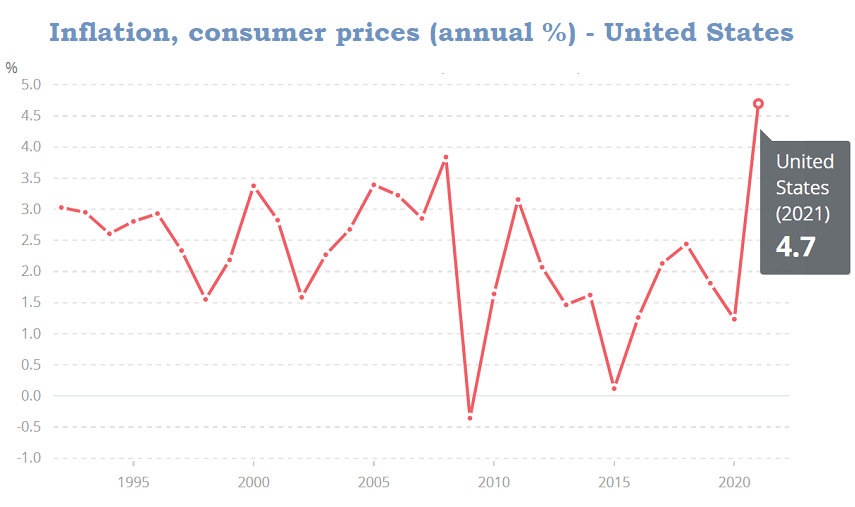
As you can see, the ratio reached 4.7% in 2021. So, it’s high time to spend your money wisely. Fortunately, Google has introduced a new price comparison feature for Google Shopping to help you survive in this current global economic condition.
As the name states, the Google Shopping price comparison feature works just like another price comparing feature — but built directly into Google’s search results and the Shopping tab. It acts as a comparison shopping engine that lets users compare the product price among the available stores and find the best available deals online.
In simple terms, comparison shopping means evaluating the same product across multiple sellers to find the lowest price, best shipping terms, or highest-rated store. Google Shopping makes this process easy by bringing all that product pricing data into one place.
Whenever the users search for a product on Google Shopping, they will get a price comparison section like the image below–
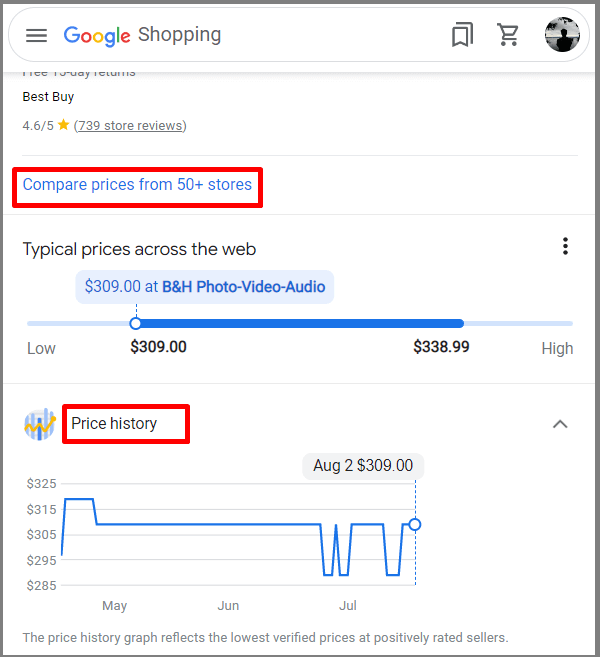
As you can see, this feature comes with four significant benefits. These are –
- Comparing product prices on multiple merchants
- Typical price across the web
- Price changing history
- Tracking product price
Here’s the Google’s official GIF presentation to understand this price comparison tool better – Source: blog.google

Let’s explain these new features of Google Shopping in brief.
1. Comparing Product Price
The very first thing you might notice about this update is the price comparing feature. Whenever you browse a product from the Google Shopping page, you will get an option called ‘Compare prices from XX pages’.
This is the “compare prices button” that Google displays directly on the product listing page. By using this feature, you can compare the price of a particular product among multiple websites — it works as a built-in Google price checker that saves you from visiting each store individually.
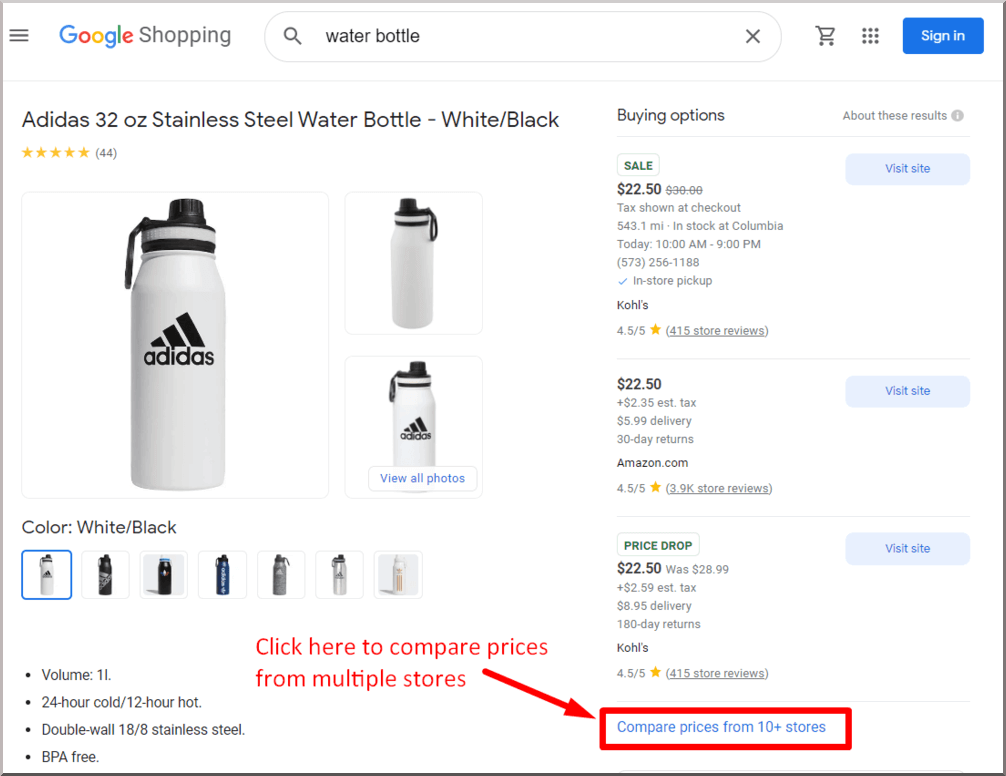
By clicking here, you will get multiple price-comparing options. This option offers multiple price comparing parameters to make the comparison easier than ever.
While exploring Google’s price comparison, it’s key for eCommerce businesses to gather accurate, up-to-date product information across various online platforms efficiently. A robust web scraping API can streamline collecting this critical data, ensuring competitive pricing and product placement. It empowers users to automate the extraction of product details, pricing, and availability from numerous retail websites effortlessly.
Here’s a list of common parameters that you may notice on the product comparison page –
- Brand name
- Special price
- Item price
- Store’s rating
- The Trusted Store badge
- Google Guarantee facility
- Total product price, etc.
By clicking here, you will get multiple price-comparing options. This option offers multiple price comparing parameters to make the comparison easier than ever.
Here’s the price comparison page for the Adidas 32 oz Stainless Steel Water Bottle –
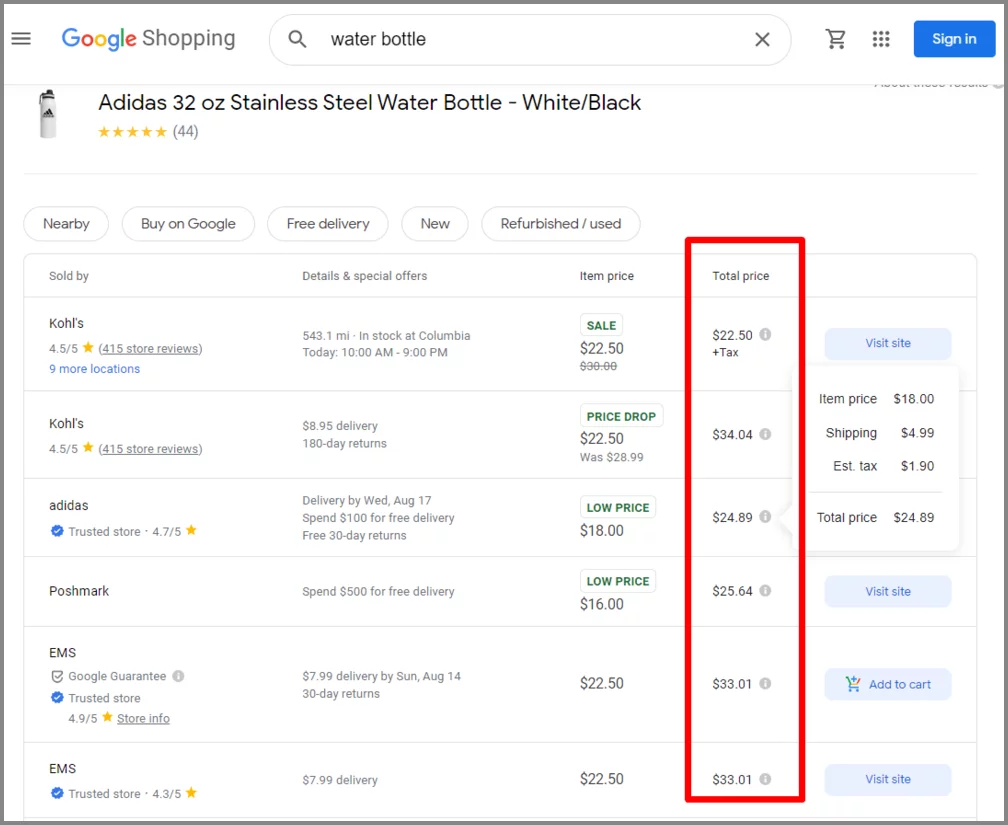
The Total price of a product includes product price, shipping charge, tax, etc. This total price is what Google uses when it ranks stores in its price comparison results.
Overall, you can say that it’s a great Google product price comparison tool in terms of purchasing products within a tight budget.
2. Typical Prices Across the Web
The typical price comparison feature is a new addition to Google Shopping. It displays a price bar showing the average price of that particular product across multiple retailers on the web.
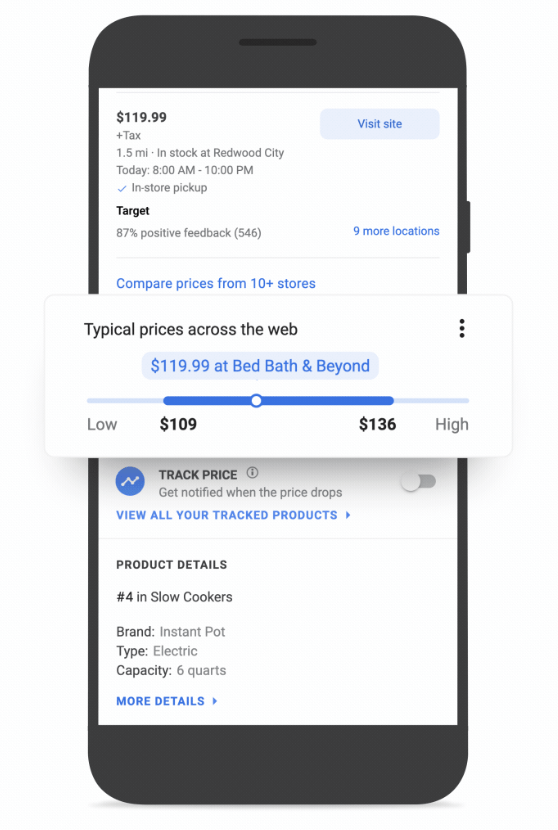
It helps the shoppers to choose the price range of a product and quickly understand whether a deal is genuinely good or just average. This feature essentially acts as a Google price finder — showing you where a specific offer stands compared to the typical market rate.
However, the product owners can also use this feature to promote their brand on Google Shopping. You may already notice that Google displays the brand name that offers a better deal than others. If you put a reasonable price against your product, then there’s a possibility of being mentioned at the top of this price bar. It increases the possibility of selling your products.
For retailers, monitoring these typical price ranges helps with competitor price comparison and ensures your pricing strategy stays competitive across the web.
3. Price History
As the name states, the Price history option helps the shoppers to check the product’s historical price. The Google Shopping price history graph shows how a product’s price has changed over time, making it easy to spot pricing trends. By analyzing the historical pricing information of a product, the customers can easily understand some insights about a product. For example, it could be like the maximum & minimum price range of that product or a possible time when the price will be reduced.
Here’s an example of the price history of a product –
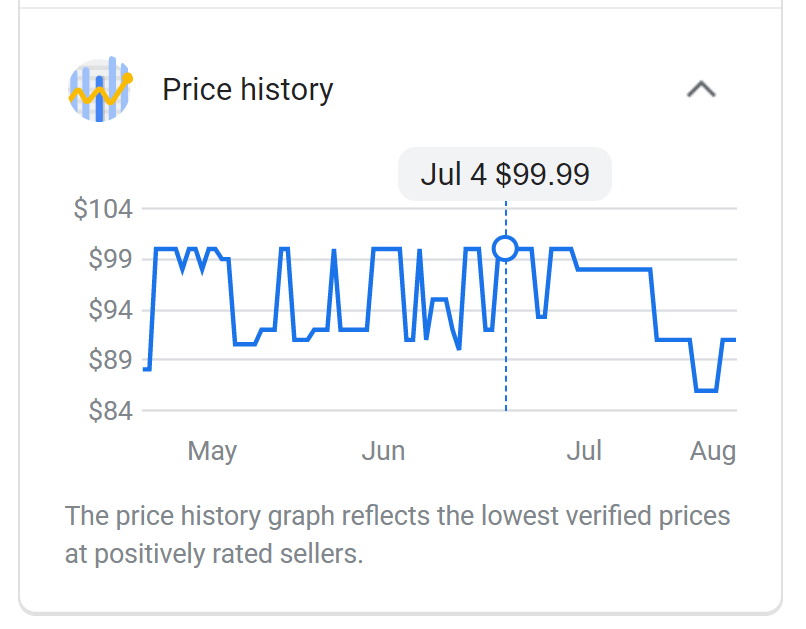
As you can see, the price history graph shows you the historical price information of your desired product. It helps the customers avoid paying a higher price during their online shopping. Simply check the graph and determine whether you are getting a better price or not.
How to check price history on Google Shopping: Search for any product on Google Shopping, click on the listing, and scroll down to find the “Price history” section. The graph automatically displays pricing trends over recent months so you can decide whether to buy now or wait for a price drop.
However, this price history helps the sellers too. When setting the product price, please check your competitor’s price history. It will help you to set your product’s price competitively. This form of Google Shopping price monitoring gives sellers a real advantage in pricing strategy.
4. Tracking Product Price
Do you know that 94% of people search for discounts or offers when shopping online?
Why?
Because customers are not only saving some bucks but also it triggers the FOMO among them.
That’s why it’s better to provide a certain amount of discounts periodically (if possible). Google Shopping’s built-in price tracker lets shoppers set price alerts on specific products. Whenever the price drops, shoppers tracking that product will be notified of the discount. And after being notified, most of the people end up purchasing that product.
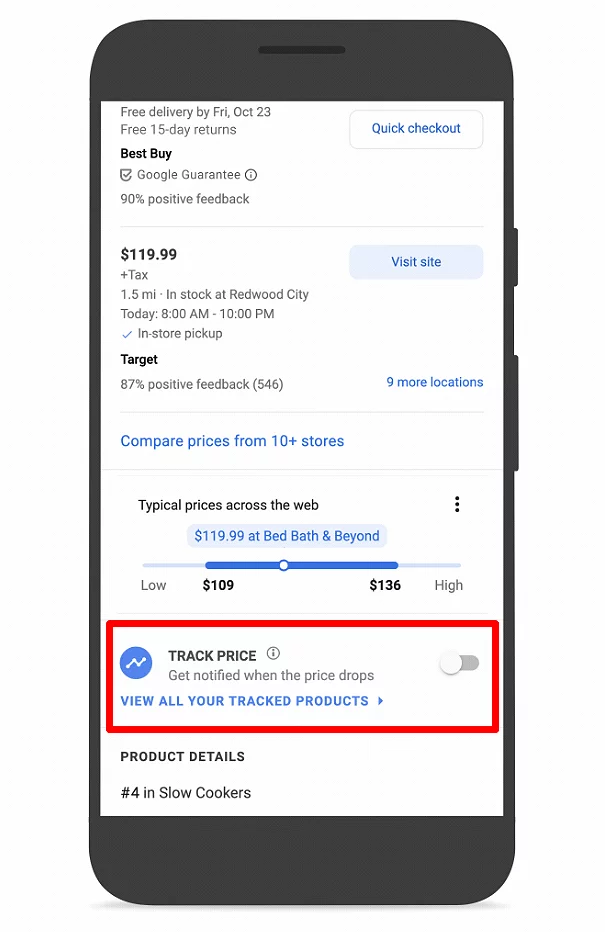
The Google Shopping price tracking feature works similarly to third-party price alert tools — but it’s built right into Google’s ecosystem, making it more convenient. You don’t need a separate price tracker app; Google handles the price drop alerts directly.
So, the customers are getting discounts, and sellers are also getting more sales. Overall, this Google Shopping price tracker option seems like a win-win situation for both, isn’t it?
Well, these are the main benefits of the Google Shopping price comparison feature. So, optimize these to grow your business and enjoy the benefits!
See more: 20 Google Shopping Ads Benefits You Might Not Know Yet!
How to Compare Prices in Google Shopping (Step-by-Step)
Many shoppers search for “how to compare prices” or “how to compare prices online” but aren’t sure where to start. Here’s a quick step-by-step guide to using Google’s price comparison feature:
- Go to Google Shopping — Visit shopping.google.com or click the “Shopping” tab in Google Search results.
- Search for your product — Type the product name, brand, or category into the search bar.
- Click on a product listing — Select any product that interests you from the search results.
- Find the “Compare prices” button — Below the main product image and details, look for the “Compare prices from XX stores” link.
- Review price comparisons — You’ll see a list of retailers, their prices, shipping costs, store ratings, and total price breakdowns.
- Check the price history graph — Scroll down to see how the price has changed over time.
- Set a price alert — Click “Track price” to get notified when the price drops.
This process makes it easy to compare product prices from different websites without visiting each store individually. It’s one of the simplest ways to compare prices online and ensure you’re getting the best deal.
How to Sort and Filter by Price in Google Shopping
A common question shoppers ask is how to sort Google Shopping results by price or filter products within a specific price range. Here’s how it works:
Sorting by price: After searching for a product on Google Shopping, look for the sorting options near the top of the results page. You can sort products from low to high or high to low by price. This makes it easy to find the lowest price for any product quickly.
Filtering by price range: On the left side of the Google Shopping results page (or in the filter menu on mobile), you’ll find a price filter option. You can set a minimum and maximum price to narrow down results to products within your budget. This price filter is especially useful when comparison shopping across hundreds of product listings.
These sort and filter features, combined with the price comparison tool, make Google Shopping one of the most powerful comparison shopping engines available today.
How to Utilize the Google Shopping Price Comparison Feature to Grow Your Business
The Google price comparison feature not only helps the customer to get a better deal but also helps the sellers to grow their business. In this section, we will discuss how this price comparison tool will help sellers to grow their business.
1. Better Customer Insights
In this era of the eCommerce revolution, people love to shop online because of its convenience and better pricing. A survey found that nearly 36% of total US consumers are now purchasing their retail goods online.
An increasing number of customers not only generates better revenue but also helps to understand the core insights about the potential customers. A few potential insights will be like –
- Understanding the demand of your target customers.
- Understanding the way a customer thinks about a product.
- How does a customer compare the products?
- What are the top features they consider while purchasing products?
These are the common insights that the seller might understand if they can increase customer retention.
So, how to use the Google Shopping price comparison tool to increase customers?
Well, as a seller, you can offer the best deals in the market to attract new customers. Use the Google Shopping price comparison data to understand what prices competitors are offering. After the customer retention rate increases, it will automatically generate more revenue as well as provide you with better insights about the market.
2. Expanding Business with Competitive Pricing
Who doesn’t want to grow their business, right?
Well, you can utilize the price comparison tool of Google to grow your business.
How?
Optimize the optimal pricing strategy using Google’s price comparison and competitor price analysis tools. By regularly checking Google Shopping prices and comparing them against your own, you can identify pricing gaps and opportunities. After optimizing it, promulgate that and try your best to attract new shoppers. This optimal pricing analysis — often called e-commerce price comparison — will help you to detect the most profitable sales channels. It definitely helps to grow the business.
Many retailers also use price comparison software for retailers to automate this competitive pricing analysis at scale.
3. Increasing Brand Awareness
Do you know that 83% of marketers use word-of-mouth marketing strategy to increase their brand awareness?
And, the best way of utilizing word-of-mouth marketing strategy is by offering discounts to potential customers.
So, upload your products to Google Merchant Center and promote those via the Google Shopping tab with additional discounts. If so, Google will automatically put a sale or price drop badge on your products.
Use the CTX Feed WooCommerce Product Feed Manager plugin to generate the most error-free and optimized product feed to submit product information on Google Shopping.
Because offering accurate product information with additional discounts will attract most of the potential customers to purchase your products online. As people tend to share discount information with their friends or others, it increases the possibility of generating more sales for you.
Overall, you are generating more revenue as well as increasing brand awareness only by offering discounts and utilizing that with the Google Shopping price comparison feature.
4. Monitor Competitor Prices with Google Shopping
One of the most underutilized benefits of Google’s price comparison feature is competitor price monitoring. As a retailer or eCommerce store owner, you can use Google Shopping as a free competitor price comparison engine to track how other sellers price similar products.
Here’s how to use it for price monitoring:
- Search for your own products on Google Shopping and see which competitors appear in the price comparison results.
- Compare your total price (including shipping) against other retailers to ensure competitiveness.
- Track price changes over time using the price history feature to understand competitor pricing trends.
- Adjust your pricing strategy based on real market data rather than guesswork.
This approach to Google Shopping price monitoring helps you stay competitive without investing in expensive third-party price comparison software. It’s particularly valuable for small to medium eCommerce businesses that need accurate price benchmarks.
So, these are the common tactics to utilize the price comparison feature of Google. Implement those and start growing your business!
Google Shopping Price Tracker: How Price Monitoring Works
Google Shopping’s built-in price tracker is one of its most practical features for both shoppers and sellers. Here’s everything you need to know about how Google Shopping price tracking works:
For shoppers:
- When you find a product you’re interested in, look for the “Track price” button on the product detail page.
- Google will send you notifications (via email or the Google app) whenever the price drops below a certain threshold.
- You can manage all your tracked products from your Google account settings.
- The price drop alerts work across all retailers listed on Google Shopping.
For sellers:
- When shoppers track your products, it means they have high purchase intent — they’re waiting for the right price.
- Offering periodic discounts or price drops can trigger notifications to all tracking shoppers, driving a surge in sales.
- Google Shopping price alerts essentially create a built-in remarketing channel at no extra cost.
The Google Shopping price tracker is a powerful alternative to standalone price tracking apps like CamelCamelCamel (which only works for Amazon). Since Google Shopping aggregates prices from thousands of online stores, its tracking feature offers broader coverage for online shopping price comparison.
Alternatives to Google Shopping Price Comparison
Using the Google Shopping tab might be one of the best places to get acknowledged about product deals and discounts. But, there are also some alternative price comparison websites and tools worth exploring. These comparison shopping sites each have unique strengths depending on what you’re shopping for.
Let’s have a look at some of those alternatives –
- CamelCamelCamel – One of the most popular price comparison sites that specializes in Amazon price tracking. It shows detailed price history graphs and lets you set price drop alerts for any Amazon product. Ideal if you primarily shop on Amazon.
- Visualping – Notifies the users whenever a website’s content changes (including the product price). Useful as a general-purpose price monitoring tool for any online store.
- NowInStock – Widely used to check the availability of hard-to-find items online. Great for tracking restocks on high-demand products.
- Pronto – A comparison shopping engine that compares the prices of similar products from multiple online stores. It works as an independent price comparison website with its own product database.
- BizRate – This price comparison site allows users to set price alerts for specific products and read store reviews before purchasing. It’s one of the older comparison shopping engines still active today.
- Shopzilla – A well-known comparison shopping engine that allows users to search different lists of products by different retailers. It covers a wide range of product categories.
- PriceGrabber – Another veteran price comparison website that aggregates product pricing from multiple retailers. It’s especially useful for electronics and tech products.
- PriceRunner – A popular price comparison site in Europe and the UK that helps shoppers find the best deals by comparing prices across hundreds of online stores.
These are the most common price comparison tools and websites you may use instead of Google’s comparison tool. Many shoppers use a combination of these comparison shopping engines alongside Google Shopping for the most comprehensive product price comparison.
Frequently Asked Questions
Here are some common questions about Google Shopping price comparison that shoppers and sellers frequently ask.
Can I sort Google Shopping products by price?
Yes, Google Shopping products are easily customizable by multiple parameters like price, color, brand, product condition, seller, product category, etc. You can sort by price (low to high or high to low) to quickly find the cheapest or most premium options available.
How do I filter prices in Google Shopping?
The price filtering option is available in the Google Shopping tab. Simply search for a specific product, and you will get the price filtering option on the left side (desktop) or in the filter menu (mobile). You can set a minimum and maximum price range to narrow your search results.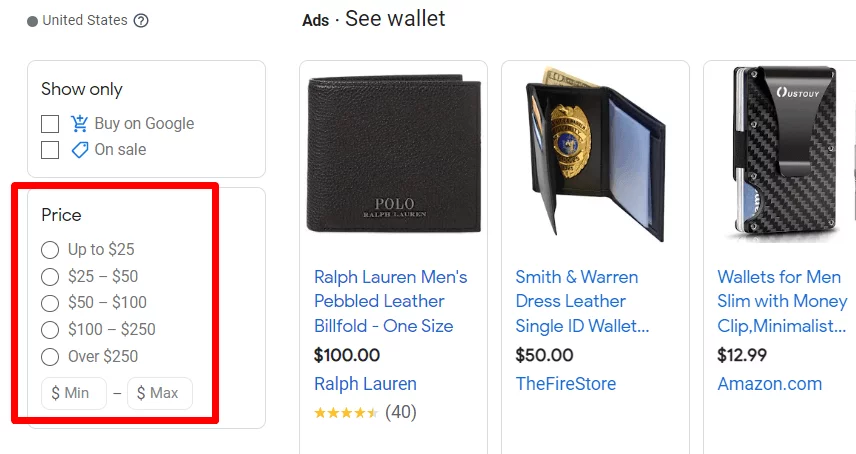
How do I compare prices in Google Shopping?
Once you select a product from the Google Shopping tab, you will get detailed information about the product from there. Look for the “Compare prices from XX stores” link to see side-by-side pricing from different retailers. Also, scroll down to find the price history option, where you will get a graph representing your desired product’s price history. This makes it easy to compare prices from different websites in one place.
Does Google Shopping compare prices automatically?
Yes, Google Shopping automatically aggregates and compares product prices from thousands of online retailers. When you search for a product, Google pulls pricing data from all available merchants and displays it in an easy-to-read comparison format. This automatic price comparison across the web is what makes Google Shopping one of the best price comparison tools available.
What is comparison shopping?
Comparison shopping is the practice of comparing prices, features, and reviews of the same product across multiple retailers before making a purchase. The goal is to find the best possible deal. Google Shopping acts as a comparison shopping engine by automatically gathering and displaying product information from various online stores, making the entire process faster and more convenient.
Is there a Google Shopping price comparison app?
While Google doesn’t offer a standalone price comparison app, the Google Shopping experience is fully integrated into the Google app and Google Search on mobile devices. You can access all price comparison features — including price tracking, price history, and comparing prices across stores — directly from your mobile browser or the Google app. For those looking for a dedicated price comparison app, several third-party options like CamelCamelCamel and ShopSavvy are available.
How do I check the price history of a product on Google Shopping?
To check a product’s price history on Google Shopping, search for the product, click on the listing, and scroll down to the “Price insights” or “Price history” section. You’ll see a graph showing how the price has fluctuated over recent weeks or months. This Google Shopping price history graph helps you decide whether to buy now or wait for a better deal.
Can I set price alerts on Google Shopping?
Yes, Google Shopping allows you to track prices and receive alerts when a product’s price drops. Simply find the product you’re interested in and click the “Track price” button. Google will notify you via email when there’s a significant price drop, working as a built-in price alert system.
Conclusion
Though it seems like the Google Shopping price comparison feature is solely beneficial for the customers, it helps the eCommerce owners too. By offering the deals, eCommerce owners can increase their sales, yearly revenue, or conversion rate. Whether you’re a shopper looking to compare prices online or a retailer using Google Shopping as a competitor price comparison engine, this feature offers real value for everyone.
The price comparison tool, combined with price history tracking, price alerts, and typical price benchmarks, makes Google Shopping one of the most comprehensive comparison shopping platforms available today. For sellers, it’s also a powerful price monitoring tool that provides insights into market pricing and competitor strategies.
So, no more waiting only for the holiday season to offer discounts for everyone. Offer better deals to potential customers using Google’s price tracker tool and outrun your competitors in terms of customer acquisition and growth rate!
By doing so, your future self will definitely thank you later!


I found your blog to be very informative and helpful for those who want to create their own price comparison website. It is a great resource for anyone looking to create a Google Shopping price comparison website. Thank you for sharing your knowledge and expertise on this topic!
Glad to know that it helped!