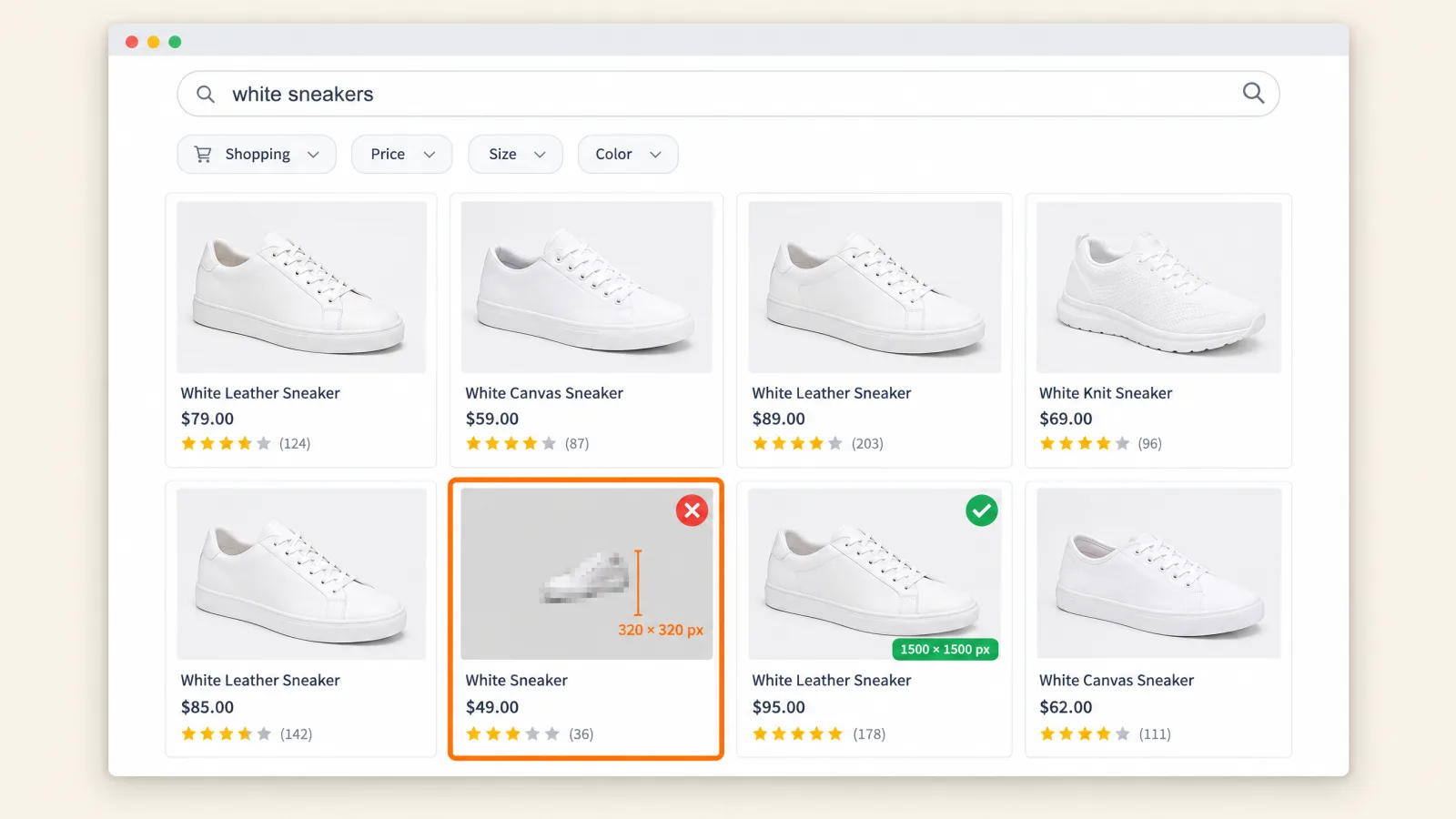
Every product in Google Merchant Center needs one main image in image_link. Today it must be at least 100 x 100 pixels (250 x 250 for clothing). From January 31, 2027, every product image must be at least 500 x 500 pixels. Google recommends around 1500 x 1500 or larger, with a ceiling of 64 megapixels and 16 MB. Use JPEG, WebP, PNG, non-animated GIF, BMP or TIFF, with no promotional text, watermarks or borders. You can add up to 10 additional images and up to 5 lifestyle images. On WooCommerce, the fix happens in your product photos and your feed, not in Merchant Center.
Rules checked against Google Merchant Center Help on October 20, 2026. Each rule below names the Google page it comes from.
Google Shopping image requirements: quick reference (2026–2027)
| Rule | Main image image_link | additional_image_link | lifestyle_image_link |
|---|---|---|---|
| Required? | Yes, for every product | Optional but recommended | Optional |
| How many | 1 | Up to 10 | Up to 5 |
| Minimum size before Jan 31, 2027 | 100 x 100 px; clothing 250 x 250 px | Same rules as the main image | 600 x 600 px |
| Minimum size from Jan 31, 2027 | 500 x 500 px | 500 x 500 px | 600 x 600 px |
| Recommended size | Around 1500 x 1500 px or above | Same as main | The largest full-size image you have |
| Maximum | 64 MP and 16 MB | Same as main | 64 MP and 16 MB |
| Formats | JPEG, WebP, PNG, non-animated GIF, BMP, TIFF; the file extension must match the format | Same | Same |
| URL | http or https, ASCII only, RFC 3986, 1–2,000 characters | Same | Same |
| Overlays, watermarks, borders | Not allowed | Not allowed | Not allowed, and no padding |
| Framing | Product fills 75–90% of the image (best practice) | Staging, in-use and detail shots allowed | Real-world context |
| Aspect ratio | Not specified | Not specified | Google’s page says “between 2:0 and 2:3” |
| If too small | Product is disapproved | Product stays, image isn’t shown | Image isn’t shown |
Sources: image_link, additional_image_link, lifestyle_image_link, Image too small, 2026 specification update.
The 500 x 500 minimum: what changes on January 31, 2027
Google announced the change in its Merchant Center product data specification update dated April 14, 2026.
What changes. The minimum for image_link and additional_image_link rises to 500 x 500 pixels across all product categories and marketing methods. Enforcement starts January 31, 2027. Until then, 100 x 100 (250 x 250 for clothing) still meets the requirement. YouTube Shopping ads already need 500 x 500 to serve on TV.
Merchant Center is already warning you. Images that pass today’s minimum but are smaller than 500 x 500 get a warning now. Google’s help pages give different start dates for these warnings, so check your account rather than a date.
Find the affected products. In Merchant Center, open Products → Needs attention, select View history, and look for the orange warnings Image too small for upcoming enforcement and Image resolution optimizations applied. View fix → Download impacted products gives you the full list.
Don’t count on Google’s fallback. Google says it will optimise some images smaller than 500 x 500 so they meet the new rule, and marks them with a warning. It only promises this “in some cases” and “when possible”. To replace an optimised image, submit a new image larger than 500 x 500.
What to do in WooCommerce:
- Work from the downloaded list. Each row is a product whose photo needs a larger original.
- Upload the larger photo as a new file with a new file name, and set it as the product (or variation) image. A new URL gets the new image crawled faster (see Replacing a photo).
- Regenerate your product feed so Google gets the new image links.
Don’t upscale a small photo to hit 500 pixels: Google says not to scale up images or submit thumbnails. Shoot or export a larger original instead.
Why images matter for Google Shopping ads and free listings
Your main image is the first thing shoppers see across Google channels. If it breaks Google’s image requirements, the product won’t appear on Google surfaces, and Merchant Center shows a notification under Diagnostics. A product without an image of the right dimensions is disapproved. For the wider picture, see our complete guide to Google Shopping ads and our guide to organic (free) listings on Google Shopping.
Image formats and URL rules
Formats
Google accepts JPEG (.jpg/.jpeg), WebP (.webp), PNG (.png), non-animated GIF (.gif), BMP (.bmp) and TIFF (.tif/.tiff). Animated GIFs are not on that list. The file extension must match the real format: a PNG saved as .jpg can trigger an Unsupported image type error.
Image URL rules
- Start with http or https, use ASCII characters only, follow RFC 3986, and stay within 1–2,000 characters.
- Replace symbols and spaces with URL-encoded entities, for example
&→%26and,→%2C. - Let Googlebot and Googlebot-Image crawl your images in robots.txt. A robots.txt change can take 24–48 hours to take effect.
- Use stable URLs: no timestamps or session IDs that change with every feed submission.
- Adding new products? Google suggests checking a few image links with the URL Inspection Tool in Search Console before you submit.
image_link vs additional_image_link vs lifestyle_image_link
image_link: one main image, a clean view of the product.additional_image_link: other angles, details, staging or the product in use.lifestyle_image_link: the product in a real-world setting, such as clothing on a model or furniture in a room.
In an XML feed, repeat the element once per image. In a text (CSV/TSV) feed, put several URLs in one cell separated by commas, and encode any comma inside a URL as %2C:
<g:image_link>https://www.example.com/image1.jpg</g:image_link>
<g:additional_image_link>https://www.example.com/image2.jpg</g:additional_image_link>
<g:additional_image_link>https://www.example.com/image3.jpg</g:additional_image_link>
additional_image_link
https://www.example.com/image2.jpg,https://www.example.com/image3.jpgMain image rules: what Google requires
Google lists requirements (break one and the image is disapproved) and separate best practices.
Requirements
Your main image must give an unobstructed, clean view of the item for sale. Don’t add:
- calls to action (“Buy”, “Shop now”);
- price, discount or shipping text (“Free shipping”);
- service or warranty claims;
- promotional adjectives (“Best”, “Cheap”);
- condition or compatibility labels (“New”, “2-piece set”);
- barcodes, QR codes or serial tags;
- watermarks, copyright symbols or graphic stamps;
- brand, manufacturer or retailer names and logos added in editing. A logo is fine only if it’s physically part of the product.
Also don’t submit:
- placeholders such as “Coming soon”, “No image available” or “Photo pending”;
- your store logo or stock icons instead of a product photo;
- one stand-in photo reused across different products;
- line art, mockups or illustrations that don’t show the real product;
- a single-colour square;
- an image with a border;
- products that aren’t sold together with the main product.
AI-generated images must keep the metadata that marks them as AI-generated, such as the IPTC DigitalSourceType tag. Don’t strip it.
Packaging shots should show multidimensional packaging, not just the front of the box.
Category exceptions
Google allows these exceptions to the main-image requirements:
- A generic image or illustration is allowed for Hardware (ID 632), Vehicles & Parts (ID 888) and Software > Computer Software (ID 313).
- Software logos or icons are allowed for Software > Computer Software (ID 313).
- A single-colour image is allowed for Vehicle Paint (ID 3812), Craft Paint, Ink & Glaze (ID 505378) and Painting Consumables (ID 503740).
Best practices
- One image per variant. Submit a distinct image for every variant, showing its exact colour, pattern, finish and material, and only that variant. Don’t reuse one photo across variations.
- Customised products. Show the customisation on a customised listing, and an uncustomised photo on an uncustomised one.
- Framing. The product should fill at least 75% and no more than 90% of the image.
- No upscaling or thumbnails.
Google can also fix minor problems such as promotional overlays if you turn on automatic image improvements in Merchant Center, and it may test subtle cropping to frame the product better.
Google Merchant Center image requirements by product type
- Clothing: at least 250 x 250 until January 31, 2027, then 500 x 500 like every other product.
- Variable products (sizes, colours): a unique image per variant (best practices above).
- Bundles: additional images may show parts of a bundle instead of every item. Mark custom bundles with the
is_bundleattribute. - Multipacks: additional images may show the entire multipack. Mark custom multipacks with the
multipackattribute. In Google’s own multipack example, the main image shows a single bar of soap and an additional image shows all three. - Customised products: match the image to the listing.
- Hardware, vehicles, software and paint: see the category exceptions.
Does Google Shopping require a white background?
No. Google’s image requirements don’t mention a white background. What they require is an unobstructed, clean view of the product with no added text, overlays or borders. A plain, light background is a practical way to meet that, and Google’s own examples describe main images “on a white background”. Treat white as a choice, not a rule.
In-context shots belong in the other two attributes: staging and in-use photos in additional_image_link, and real-world scenes in lifestyle_image_link, where Google advises against plain white backgrounds.
Additional images and lifestyle images: rules and limits
additional_image_link
- Optional but recommended, up to 10 per product.
- Must meet the same requirements as
image_link, but may show staging, the product in use, or part of the product. - An additional image under the minimum size doesn’t get the product disapproved. The image just isn’t shown.
- Avoid brand-only or logo images, blurry or misshapen photos, and watermarks or store text.
lifestyle_image_link
- Optional, up to 5 per product. Lifestyle images can be shown in free listings.
- At least 600 x 600 pixels.
- Aspect ratio: Google’s page says “between 2:0 and 2:3”. “2:0” looks like a typo on Google’s page, so check the page before you crop to an exact ratio.
- No promotional text or overlays, including watermarks, brand names, logos, retailer name and price.
- No borders, and no padding added to reach the aspect ratio.
- Send the largest full-size image you have (up to 64 MP and 16 MB), and don’t upscale.
How to configure images for Google Shopping in CTX Feed
A WooCommerce store shouldn’t type image URLs into Merchant Center one product at a time. CTX Feed builds the Google feed from images your store already has: the product image becomes the main image and the product gallery becomes the additional images, so nothing is uploaded twice. Here is how to set it up:
- In your WordPress dashboard, open CTX Feed → Make Feed, or edit an existing feed from Manage Feeds.
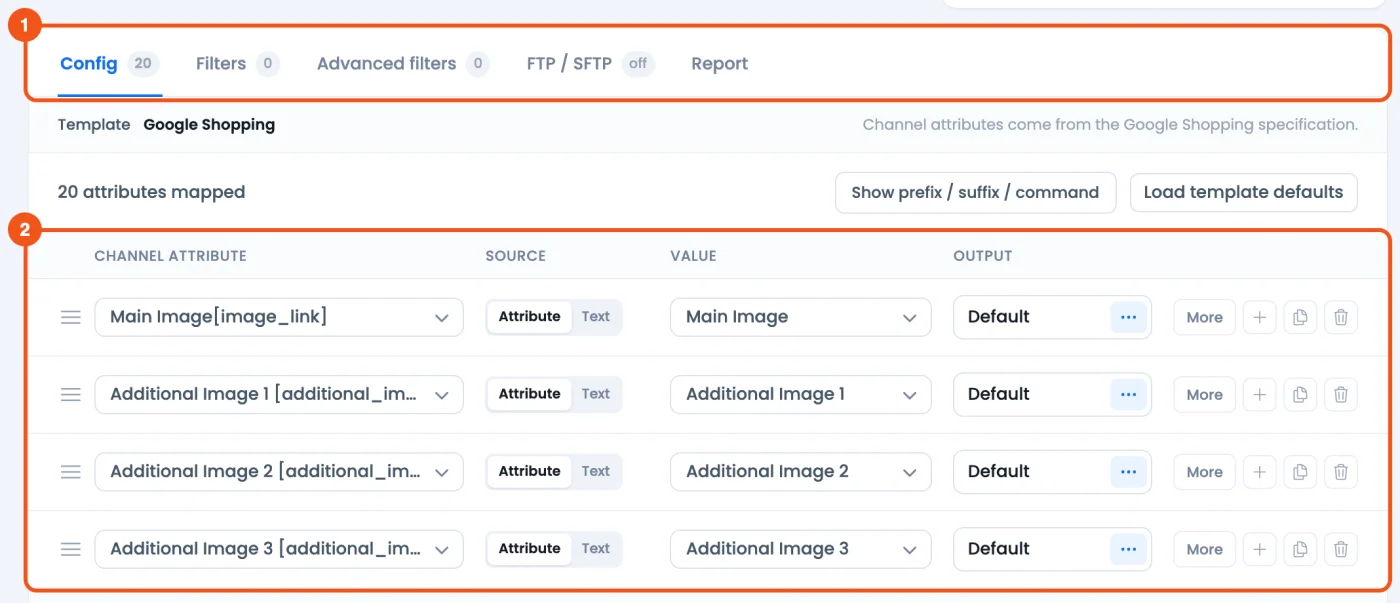
- Choose Google Shopping as the Template. This loads Google’s attributes and pre-fills the mapping. Then open the Config tab.
- Check the main image row.
image_linkshould have Source set to Attribute and Value set to Main Image. A new Google feed maps it for you. Keep Main Image rather than Featured Image, so each variant sends its own photo. - Check the additional image rows. Additional Image 1 to Additional Image 5 are already mapped. If your product galleries hold more than five photos, click Add attribute, choose Additional Image 6 [additional_image_link] as the channel attribute and Additional Image 6 as the value, and repeat up to Additional Image 10. Otherwise the extra photos won’t reach Google.
- Optional: add a lifestyle image. Click Add attribute, choose Lifestyle Image Link [lifestyle_image_link] as the channel attribute, and set the value to the image that holds your lifestyle photo.
- Optional: force HTTPS. In the Output column of an image row, choose urlToSecure.
- Click Save & generate. Then open the feed from Manage Feeds and click an image link to check it loads in a browser.
- Submit the feed to Merchant Center: see Upload a WooCommerce product feed to Google Merchant Center.
For every option on the image rows, see Configure product images into feed.
How CTX Feed handles your images
- You send the full-size file. CTX Feed links the full-size image file, not a WooCommerce thumbnail. The size Google measures is the full-size image in your WordPress media library. If Merchant Center says Image too small, upload a larger original. Changing your theme’s thumbnail sizes won’t help (more on store image sizes in WooCommerce product image size).
- Variation images are picked automatically. For a variable product, Main Image sends each variation’s own image when you’ve set one, and the variable (parent) product’s image when the variation has none. Google wants a unique image per variant, so give each variation its own photo where you can.
- Want the variable product’s image on every variation instead? Set the image row’s Output to parent. Each variation then sends the variable product’s image and skips its own, keeping its own only if the variable product has no image. Choosing Featured Image as the value also sends the parent’s photo for every variant.
- Each filled row is one additional image. Each filled row becomes its own
g:additional_image_link, and empty rows are skipped. - Variations send their own gallery. The additional-image attributes read only the variation’s own gallery and don’t fall back to the parent’s, so a variation without its own gallery sends no additional images. To send the variable product’s gallery for those variations, set the additional-image rows’ Output to parent_if_empty. Gallery images from variation-gallery plugins such as Woo Variation Gallery and WooCommerce Additional Variation Images, and from the WoodMart theme, are read too.
- URLs come out Google-safe. Image links are full, absolute URLs. The path is percent-encoded, so spaces and accented or non-Latin file names (Cyrillic, for example) don’t break the link. Query strings such as CDN signatures stay untouched. If your site serves HTTPS, so do the image links. Since version 8.0.38, this encoding no longer depends on the server’s locale settings.
- Products with no photo stay out. With CTX Feed Pro, the Remove no-image products filter (Filters tab → Product eligibility) drops products without an image, and the WooCommerce placeholder counts as no image (steps: Remove products with no image, price or description). Don’t plug the gap with a stand-in image: Google forbids placeholders and reused generic photos.
- The feed keeps up. With Auto Update on, CTX Feed regenerates the feed on its interval, so the feed file picks up new photos without a manual export. After you replace a photo, use Clear Cache on Manage Feeds and regenerate if the feed still shows the old image.
For every other attribute, see Google product feed specifications.
Where product images appear on Google
- Shopping ads and free listings. The main image has to meet the requirements to be used in an ad or a free listing.
- Additional images can also be shown to shoppers.
- Lifestyle images can be shown in free listings.
- YouTube Shopping ads on TV need images of at least 500 x 500 already.
How to fix common Google Shopping image errors
Issue names in bold are Google’s wording in Merchant Center.
| What Merchant Center shows | What’s wrong | Fix in your store and feed |
|---|---|---|
| Image too small | The image is under 100 x 100 (250 x 250 for clothing) and can’t be used in ads or free listings | Upload a larger original, set it on the product, regenerate the feed |
| Image too small for upcoming enforcement (warning) | Passes today, but is under 500 x 500 | Same fix, before January 31, 2027 |
| Image resolution optimizations applied (warning) | Google served an optimised version of a sub-500 image | Replace it with your own image larger than 500 x 500 |
| Low image quality [image_link] | Blurry, pixelated or low-resolution image. The product keeps showing | Upload a sharper original; don’t upscale |
| Unable to show image | Google can’t fetch the image yet: slow crawl, image not live, wrong HTTP headers (content-type and content-length must be sent; don’t add cache-control), or robots.txt blocking Googlebot-Image | Make the URL public, allow Googlebot and Googlebot-Image, keep server errors down |
| Unsupported image type | The file extension doesn’t match the format, e.g. a PNG named .jpg | Re-export in the right format, or with the right extension |
| Image over 64 MP or 16 MB | Above Google’s maximum | Export a smaller file (still at least 500 x 500) |
| Promotional overlay, watermark or border | Breaks the main-image requirements | Use a clean photo, or turn on automatic image improvements |
| Placeholder or generic image | “Coming soon”, logo or shared stand-in image | Use a real product photo. In CTX Feed Pro, Remove no-image products |
Replacing a photo? Change the URL. If you change an image but keep the same URL, Google can take up to 6 weeks to notice. A new URL is typically crawled within 3 days (up to 30), and your previous image can keep showing for up to 30 days in the meantime. Fixes can take 24–72 hours to show on the Needs attention page. For the wider fix flow, see Google Merchant Center disapproved products.
Frequently asked questions (FAQs)
What size should Google Shopping images be?
At least 100 x 100 pixels (250 x 250 for clothing) until January 31, 2027, then at least 500 x 500 for all products. Google recommends around 1500 x 1500 or above, and no more than 64 megapixels or 16 MB.
Does Google Shopping require a white background?
No. Google requires a clean, unobstructed view of the product with no added text, overlays or borders, not a particular background colour.
How many images can I submit per product?
One main image (image_link), up to 10 additional images (additional_image_link) and up to 5 lifestyle images (lifestyle_image_link).
Can I use the same image for all variants?
Google asks for a distinct image for each variant, showing that variant’s colour, pattern and material. In CTX Feed, map image_link to Main Image so each variation sends its own photo.
Which image formats does Google Shopping accept?
JPEG, WebP, PNG, non-animated GIF, BMP and TIFF, with a file extension that matches the format.
What is lifestyle_image_link?
An optional attribute for up to 5 photos of the product in a real-world setting, at least 600 x 600 pixels, with no promotional text, borders or padding. Google can show them in free listings.
I replaced an image but Google still shows the old one. Why?
If the URL stayed the same, Google can take up to 6 weeks to pick up the new image. Upload the new photo under a new file name so the URL changes: a new URL is typically crawled within 3 days.
What does “At least 1 square image is required” mean?
That’s a Google Ads Performance Max image-asset rule, not a Merchant Center product-image rule. Performance Max needs at least one square (1:1) image. Google recommends 1200 x 1200 pixels, with a minimum of 300 x 300.
Wrapping up
Check your Needs attention history for Image too small for upcoming enforcement now, and replace those photos with larger originals before January 31, 2027. Then let your feed carry full-size main, gallery and variant images to Google, so you fix the photo once, in WooCommerce.
Send every product’s full-size photo, gallery and variant images to Google Merchant Center from your WooCommerce store with CTX Feed (free on WordPress.org). Want products without an image kept out of the feed automatically? CTX Feed Pro adds product-eligibility filters.

Free version on WordPress.org. Every Pro licence includes a 30-day money-back guarantee.