%22%2F%3E%0A%3Cpath%20d%3D%22M59.8894%2016.6974C60.1689%2016.9331%2060.5416%2017.1216%2060.9142%2017.0745C61.5664%2017.0273%2061.8925%2016.6031%2061.6596%2015.7547C61.5198%2014.4349%2061.4267%2013.1623%2061.2869%2011.8425C61.1006%209.72149%2060.8211%207.55331%2060.5881%205.38512L60.1689%201.70863C60.0757%200.81307%2059.6099%200.294591%2058.7713%200.106053C58.4918%20-0.0353509%2058.2123%20-0.0353509%2057.9328%200.106053C57.7931%200.106053%2057.6999%200.106053%2057.6067%200.153187C56.5353%200.483129%2055.4172%200.81307%2054.3458%201.19015C53.5073%201.47295%2052.6222%201.75576%2051.7371%202.03857C50.2929%202.50991%2048.8488%203.02839%2047.4047%203.49974C46.4264%203.82967%2045.4016%204.1596%2044.3768%204.48952L44.3767%204.48956C43.6313%204.72523%2043.3518%205.24371%2043.6313%205.85646C43.7711%206.13927%2044.004%206.32781%2044.2369%206.46921C44.7028%206.79915%2045.2152%207.08196%2045.6811%207.4119C45.8674%207.55331%2046.0537%207.69471%2045.8208%208.02465C45.7276%208.21319%2045.5879%208.35459%2045.4481%208.54313L45.355%208.73167L44.5164%2010.0986L43.9108%2010.9941L43.3052%2011.8897L43.2121%2011.9839L42.1406%2013.5865L44.5867%2019.8706C45.5713%2022.1447%2048.6357%2026.5713%2052.552%2023.6277L53.9265%2022.2593L54.3458%2021.5523C54.3924%2021.458%2054.4856%2021.3637%2054.5321%2021.2694L54.5787%2021.2223C55.2309%2020.1854%2055.883%2019.1956%2056.5352%2018.2059L56.5353%2018.2057C57.0477%2017.4044%2057.5601%2016.6503%2058.0726%2015.849C58.2123%2015.6604%2058.3055%2015.6133%2058.4918%2015.7076C58.9577%2016.0375%2059.4235%2016.4146%2059.8894%2016.6974Z%22%20fill%3D%22%233D89D0%22%2F%3E%0A%3Cpath%20d%3D%22M28.0259%2022.0232C27.9793%2022.0703%2027.9793%2022.1175%2027.9327%2022.1646C27.9793%2022.1175%2028.0259%2022.0703%2028.0259%2022.0232Z%22%20fill%3D%22url(%23paint1_linear)%22%2F%3E%0A%3Cpath%20d%3D%22M53.9265%2022.3064C53.7402%2022.5892%2053.5538%2022.872%2053.3675%2023.202C53.0414%2023.7204%2052.7153%2024.1918%2052.3892%2024.7103C51.3178%2026.4071%2050.1531%2027.9625%2048.4295%2029.0938C46.9388%2030.0365%2045.4015%2030.6021%2043.6779%2030.8849C42.1872%2031.1206%2040.7896%2030.9791%2039.3921%2030.5549C37.6219%2030.0365%2036.038%2029.1409%2034.687%2027.8211C33.7088%2026.8784%2032.9634%2025.7944%2032.3578%2024.616C32.0317%2023.9561%2031.7988%2023.2491%2031.4727%2022.5421C31.0534%2021.5522%2030.1683%2019.2427%2030.1218%2019.1012C30.0752%2019.0541%2030.0752%2018.9598%2030.0286%2018.9127C29.9354%2018.7242%2029.8422%2018.5828%2029.7957%2018.3942C29.6559%2018.0172%2029.4696%2017.6401%2029.3298%2017.2159C29.2366%2017.0273%2029.1901%2016.8388%2029.0969%2016.6503C28.9571%2016.3674%2028.864%2016.0846%2028.7242%2015.7547C28.5845%2015.3776%2028.4447%2015.0005%2028.2584%2014.6235C28.1652%2014.3407%2028.0254%2014.0579%2027.9323%2013.775C27.9323%2013.7279%2027.9323%2013.7279%2027.8857%2013.6808C27.7925%2013.4922%2027.7459%2013.3037%2027.6528%2013.1152C27.4664%2012.5967%2027.2335%2012.1253%2027.0006%2011.6069C27.0006%2011.5597%2026.954%2011.5126%2026.9074%2011.4655C26.8142%2011.2769%2026.7211%2011.1355%2026.5813%2010.947C26.5347%2010.8998%2026.4882%2010.8527%2026.4882%2010.8056C26.4416%2010.7584%2026.395%2010.7113%2026.395%2010.6642C26.3484%2010.617%2026.3018%2010.5699%2026.2552%2010.5228C26.2086%2010.4756%2026.2086%2010.4285%2026.1621%2010.4285L26.1155%2010.3814C26.0689%2010.3342%2026.0223%2010.2871%2026.0223%2010.2871C25.9291%2010.1928%2025.8826%2010.1457%2025.7894%2010.0514C25.7428%2010.0043%2025.6962%209.95715%2025.6496%209.95715C25.603%209.91002%2025.5565%209.91002%2025.5099%209.86288C25.4167%209.81575%2025.3701%209.76861%2025.277%209.67435C25.2304%209.62721%2025.1838%209.62721%2025.1372%209.58008C25.0906%209.53294%2025.044%209.53294%2024.9974%209.48581C24.9509%209.48581%2024.9043%209.43867%2024.9043%209.43867C24.8577%209.39154%2024.8111%209.39154%2024.7645%209.3444C24.7179%209.3444%2024.7179%209.29727%2024.6714%209.29727C24.5782%209.25014%2024.485%209.203%2024.3918%209.15587C22.9943%208.59025%2021.1775%208.77879%2020.1992%209.10873C19.2675%209.43867%2018.2893%2010.3342%2018.2427%2010.4285C18.6619%209.72148%2019.0812%208.96733%2019.547%208.26031C20.1526%207.36475%2020.7117%206.4692%2021.3638%205.62078C22.3887%204.63095%2023.4602%203.78253%2024.6714%203.07551C27.0006%201.75575%2029.4696%201.52007%2032.0317%201.89715C33.3361%202.08569%2034.5939%202.60417%2035.7585%203.35832C36.9231%204.06534%2037.9014%204.96089%2038.7399%206.04499C39.2989%206.79914%2039.8114%207.60043%2040.1374%208.49598C40.6033%209.67435%2041.1623%2010.8056%2041.5816%2011.9839C41.7679%2012.5496%2042.0008%2013.068%2042.2338%2013.6336C42.2338%2013.6336%2042.2338%2013.6336%2042.2338%2013.6808V13.7279L45.0288%2019.8554C45.4015%2020.8452%2045.9139%2021.6465%2046.7059%2022.3535C47.2183%2022.872%2047.8705%2023.1548%2048.5227%2023.3905C48.5693%2023.3905%2048.6158%2023.4376%2048.6624%2023.4376C49.7805%2023.7676%2051.2246%2023.3905%2052.3426%2023.0134C53.088%2022.6835%2053.6936%2022.4007%2053.9265%2022.3064Z%22%20fill%3D%22url(%23paint2_linear)%22%2F%3E%0A%3Cpath%20d%3D%22M28.0255%2022.0238C27.9789%2022.0709%2027.9789%2022.118%2027.9324%2022.1652C27.9324%2022.1652%2027.9324%2022.1652%2027.9324%2022.2123C27.7926%2022.448%2027.6063%2022.6836%2027.4665%2022.9664C25.8826%2025.8416%2024.4385%2028.1512%2021.6434%2029.6595C19.3142%2030.9793%2016.8452%2031.215%2014.2831%2030.8379C14.1433%2030.8379%2014.0501%2030.7908%2013.9104%2030.7908C12.7458%2030.6022%2011.5812%2030.0838%2010.4165%2029.2825C8.78607%2028.1512%207.52829%2026.5958%206.64318%2024.8047L6.17733%2023.9091L5.01272%2021.5524L0.726927%2012.6911C0.447419%2012.0784%200.214496%2011.4656%200.121327%2010.8529C-0.437689%207.8834%200.95985%204.77252%203.80151%203.35849C5.43198%202.51007%207.24878%202.4158%208.87924%202.93428C10.6029%203.45276%2012.1402%204.67825%2013.0253%206.46937L13.1184%206.6579L14.7489%209.95732C14.7955%2010.0516%2014.7955%2010.1459%2014.8421%2010.2401C15.075%2010.8529%2015.8204%2012.4083%2016.426%2013.5867C16.4725%2013.6809%2016.5191%2013.7752%2016.5657%2013.8223C16.6123%2013.9638%2016.7055%2014.1052%2016.752%2014.1994C16.7986%2014.2937%2016.8452%2014.3408%2016.8452%2014.4351C16.8452%2014.4822%2016.8918%2014.4822%2016.8918%2014.5294C16.9384%2014.5765%2016.9384%2014.6708%2016.985%2014.7179C16.985%2014.765%2017.0316%2014.765%2017.0316%2014.8122C17.0316%2014.8593%2017.0781%2014.8593%2017.0781%2014.9064C17.0781%2014.9536%2017.1247%2015.0007%2017.1247%2015.0478C17.1247%2015.095%2017.1713%2015.095%2017.1713%2015.1421C17.3111%2015.4249%2017.4042%2015.7549%2017.544%2016.0377C17.6372%2016.2262%2017.6837%2016.4147%2017.7769%2016.6504C17.9632%2017.1689%2018.1962%2017.6402%2018.3825%2018.1587C18.5223%2018.4415%2018.6154%2018.7715%2018.7552%2019.0543C18.8018%2019.1485%2018.8484%2019.29%2018.8949%2019.3842C18.9881%2019.5728%2019.0347%2019.7613%2019.1279%2019.9498C19.3608%2020.5154%2019.5937%2021.0811%2019.9664%2021.5995C20.1993%2021.8823%2020.3857%2022.1652%2020.6652%2022.4008C22.3888%2023.9563%2024.9975%2023.862%2028.0255%2022.0238Z%22%20fill%3D%22url(%23paint3_linear)%22%2F%3E%0A%3Cpath%20d%3D%22M68.0888%2024.8694L68%207.88696H71.9963L71.8187%2018.4448L76.8806%207.88696H80.6548L81.3209%2018.3999L85.5392%207.88696H89.713L82.4754%2024.8694H78.1683L77.5466%2013.9072L72.3959%2024.8694H68.0888Z%22%20fill%3D%22%230D5293%22%2F%3E%0A%3Cpath%20d%3D%22M92.7771%2025.1385C89.2693%2025.1385%2086.7383%2022.6675%2086.7383%2019.2081C86.7383%2015.3893%2089.8021%2012.1545%2093.4431%2012.1545C96.6402%2012.1545%2098.8603%2014.4458%2098.8603%2017.7704C98.8603%2018.5342%2098.8159%2019.1182%2098.7271%2019.6124H90.4237C90.6457%2021.0501%2091.7114%2022.0385%2093.2211%2022.0385C94.1536%2022.0385%2094.9528%2021.724%2095.5301%2021.095L97.617%2023.4762C96.0185%2024.6443%2094.5976%2025.1385%2092.7771%2025.1385ZM90.6457%2017.411H95.4857C95.3081%2016.0632%2094.4644%2015.2545%2093.2211%2015.2545C92.0666%2015.2096%2091.0898%2016.0632%2090.6457%2017.411Z%22%20fill%3D%22%230D5293%22%2F%3E%0A%3Cpath%20d%3D%22M105.965%2024.9589C104.411%2024.9589%20103.167%2024.24%20102.368%2022.8473L101.924%2024.869H98.1499L101.791%207.52717L105.698%206.89819L104.322%2013.5923C105.166%2012.7836%20106.32%2012.2894%20107.519%2012.2894C110.139%2012.2894%20112.181%2014.8054%20112.181%2018.0401C112.226%2021.814%20109.428%2024.9589%20105.965%2024.9589ZM103.789%2016.3778L102.945%2020.4212C103.478%2021.185%20104.366%2021.6792%20105.388%2021.6792C107.208%2021.6792%20108.54%2020.2415%20108.54%2018.3097C108.54%2016.6474%20107.43%2015.4793%20105.92%2015.4793C105.077%2015.4793%20104.411%2015.7937%20103.789%2016.3778Z%22%20fill%3D%22%230D5293%22%2F%3E%0A%3Cpath%20d%3D%22M120.44%207.88696H125.058L127.899%2024.8694H123.725L123.193%2020.8259H117.154L114.978%2024.8694H110.582L120.44%207.88696ZM122.704%2017.5912L121.949%2011.9304L118.886%2017.5463H122.704V17.5912Z%22%20fill%3D%22%230D5293%22%2F%3E%0A%3Cpath%20d%3D%22M131.23%2012.3347H135.004L134.782%2013.5927C135.626%2012.7391%20136.736%2012.2449%20137.935%2012.2449C140.555%2012.2449%20142.597%2014.7608%20142.597%2017.9955C142.597%2021.8143%20139.8%2024.9592%20136.336%2024.9592C134.782%2024.9592%20133.539%2024.2853%20132.828%2022.9824L131.274%2030.0809H127.456L131.23%2012.3347ZM134.205%2016.3332L133.317%2020.5114C133.85%2021.2303%20134.738%2021.6796%20135.715%2021.6796C137.535%2021.6796%20138.867%2020.2419%20138.867%2018.31C138.867%2016.6477%20137.757%2015.4796%20136.247%2015.4796C135.493%2015.4796%20134.827%2015.7492%20134.205%2016.3332Z%22%20fill%3D%22%230D5293%22%2F%3E%0A%3Cpath%20d%3D%22M144.595%2012.3347H148.369L148.147%2013.5927C148.99%2012.7391%20150.101%2012.2449%20151.299%2012.2449C153.919%2012.2449%20155.962%2014.7608%20155.962%2017.9955C155.962%2021.8143%20153.164%2024.9592%20149.701%2024.9592C148.147%2024.9592%20146.904%2024.2853%20146.193%2022.9824L144.683%2030.0809H140.865L144.595%2012.3347ZM147.57%2016.3332L146.682%2020.5114C147.214%2021.2303%20148.102%2021.6796%20149.079%2021.6796C150.9%2021.6796%20152.232%2020.2419%20152.232%2018.31C152.232%2016.6477%20151.122%2015.4796%20149.612%2015.4796C148.857%2015.4796%20148.191%2015.7492%20147.57%2016.3332Z%22%20fill%3D%22%230D5293%22%2F%3E%0A%3Cpath%20d%3D%22M159.115%2024.8694H155.296L158.005%2012.3347H161.824L159.115%2024.8694ZM158.449%208.47099C158.449%207.1681%20159.559%206%20160.847%206C161.912%206%20162.8%206.85361%20162.8%207.93186C162.8%209.27967%20161.69%2010.4029%20160.358%2010.4029C159.248%2010.4029%20158.449%209.54924%20158.449%208.47099Z%22%20fill%3D%22%230D5293%22%2F%3E%0A%3Cpath%20d%3D%22M169.727%2020.6909L171.592%2023.1619C170.304%2024.4648%20168.572%2025.1387%20166.752%2025.1387C163.466%2025.1387%20161.068%2022.7126%20161.068%2019.388C161.068%2015.3446%20164.088%2012.1099%20167.862%2012.1099C170.082%2012.1099%20171.947%2013.0983%20173.013%2014.7606L170.304%2017.0069C169.727%2015.9736%20168.927%2015.4794%20167.773%2015.4794C166.13%2015.4794%20164.842%2017.0518%20164.842%2019.0286C164.842%2020.6909%20165.819%2021.6793%20167.329%2021.6793C168.261%2021.7243%20169.016%2021.4098%20169.727%2020.6909Z%22%20fill%3D%22%230D5293%22%2F%3E%0A%3Cpath%20d%3D%22M175.722%207.52717L179.629%206.89819L177.365%2017.6807L182.426%2012.3344H187L180.517%2018.6691L184.691%2024.869H180.162L177.009%2019.5676L175.899%2024.869H172.081L175.722%207.52717Z%22%20fill%3D%22%230D5293%22%2F%3E%0A%3Cdefs%3E%0A%3ClinearGradient%20id%3D%22paint0_linear%22%20x1%3D%2223.1831%22%20y1%3D%2224.7007%22%20x2%3D%2223.3049%22%20y2%3D%228.44851%22%20gradientUnits%3D%22userSpaceOnUse%22%3E%0A%3Cstop%20stop-color%3D%22%23327ACD%22%2F%3E%0A%3Cstop%20offset%3D%221%22%20stop-color%3D%22%234696D2%22%2F%3E%0A%3C%2FlinearGradient%3E%0A%3ClinearGradient%20id%3D%22paint1_linear%22%20x1%3D%2227.9436%22%20y1%3D%2222.0876%22%20x2%3D%2228.0428%22%20y2%3D%2222.0876%22%20gradientUnits%3D%22userSpaceOnUse%22%3E%0A%3Cstop%20offset%3D%220.2029%22%20stop-color%3D%22%234C51BF%22%20stop-opacity%3D%220.9%22%2F%3E%0A%3Cstop%20offset%3D%221%22%20stop-color%3D%22%235A67D8%22%20stop-opacity%3D%220.9%22%2F%3E%0A%3C%2FlinearGradient%3E%0A%3ClinearGradient%20id%3D%22paint2_linear%22%20x1%3D%2232.4583%22%20y1%3D%222.22148%22%20x2%3D%2239.8371%22%20y2%3D%2230.0298%22%20gradientUnits%3D%22userSpaceOnUse%22%3E%0A%3Cstop%20offset%3D%220.3367%22%20stop-color%3D%22%2342B9FF%22%2F%3E%0A%3Cstop%20offset%3D%220.7818%22%20stop-color%3D%22%233B97E1%22%2F%3E%0A%3Cstop%20offset%3D%221%22%20stop-color%3D%22%233784D1%22%2F%3E%0A%3C%2FlinearGradient%3E%0A%3ClinearGradient%20id%3D%22paint3_linear%22%20x1%3D%2211.252%22%20y1%3D%220.972585%22%20x2%3D%2215.8771%22%20y2%3D%2225.7529%22%20gradientUnits%3D%22userSpaceOnUse%22%3E%0A%3Cstop%20offset%3D%220.3367%22%20stop-color%3D%22%2342B9FF%22%2F%3E%0A%3Cstop%20offset%3D%220.7818%22%20stop-color%3D%22%233B97E1%22%2F%3E%0A%3Cstop%20offset%3D%221%22%20stop-color%3D%22%233784D1%22%2F%3E%0A%3C%2FlinearGradient%3E%0A%3C%2Fdefs%3E%0A%3C%2Fsvg%3E%0A)


Facebook Product Feed Template: The Ultimate Guide (2026)
 Fadiyah Sameh
 ⚡ Key Takeaways
- A Facebook product feed is a CSV, TSV, or XML file uploaded to Meta Commerce Manager to list and advertise products on Facebook & Instagram.
- Required fields include:
id,title,description,availability,condition,price,link,image_link, andbrand.- The fastest way to create a feed for WooCommerce is with CTX Feed — select the Facebook template and click Generate.
- You can use one feed for both Facebook and Instagram via Meta Commerce Manager.
With over 3 billion monthly active users and 250 million active shops, Facebook is one of the most powerful sales channels for eCommerce stores — but listing your products one by one is simply not practical.
That’s where a Facebook product feed comes in.
A Facebook product feed is a structured file (CSV, TSV, or XML) containing all your product data — titles, prices, images, availability — formatted exactly the way Meta requires. You upload it once to Meta Commerce Manager, and it instantly populates your Facebook Shop, Instagram Shopping, and Dynamic Ads catalog.
In this guide, you’ll learn:
- What a Facebook product feed template looks like (with real CSV and XML examples)
- Every required and optional field Meta expects in 2025
- How to download the official Facebook catalog feed template
- How to automate the entire process for your WooCommerce store with CTX Feed
- How to fix the most common feed errors
Whether you’re setting up your first Facebook catalog or troubleshooting an existing feed, this guide covers everything you need.
What Is a Facebook Product Feed?
A Facebook product feed (also called a Meta product feed or Facebook catalog feed) is a structured data file that contains all the information about your products — titles, prices, images, availability, and more — formatted exactly the way Meta requires.
You upload this file to Meta Commerce Manager, where it populates your Facebook catalog. That catalog is then used across:
- Facebook Collaborative Ads — partnership ads with retailers
- Facebook Shop — your storefront on your Facebook page
- Instagram Shopping — product tags on Instagram posts & stories
- Facebook Dynamic Ads — personalized retargeting ads showing products users already viewed
- Facebook Marketplace — bulk product listing for local and online selling
Why is this important? Facebook has over 3 billion monthly active users and 250 million active shops. Without a product feed, you would need to add every product individually — an impossible task for stores with more than a handful of items.
A product data feed is a file that contains your store’s product data organized under specific column headers (called attributes). Here’s what a basic Facebook product feed CSV looks like:
id,title,description,availability,condition,price,link,image_link,brand
SKU001,"Blue Running Shoes","Lightweight running shoes for men",in stock,new,59.99 USD,https://yourstore.com/blue-shoes,https://yourstore.com/img/blue-shoes.jpg,YourBrand
The column headers (id, title, description, etc.) are the attributes. Each row represents one product. This is exactly what your Facebook product feed template should look like.
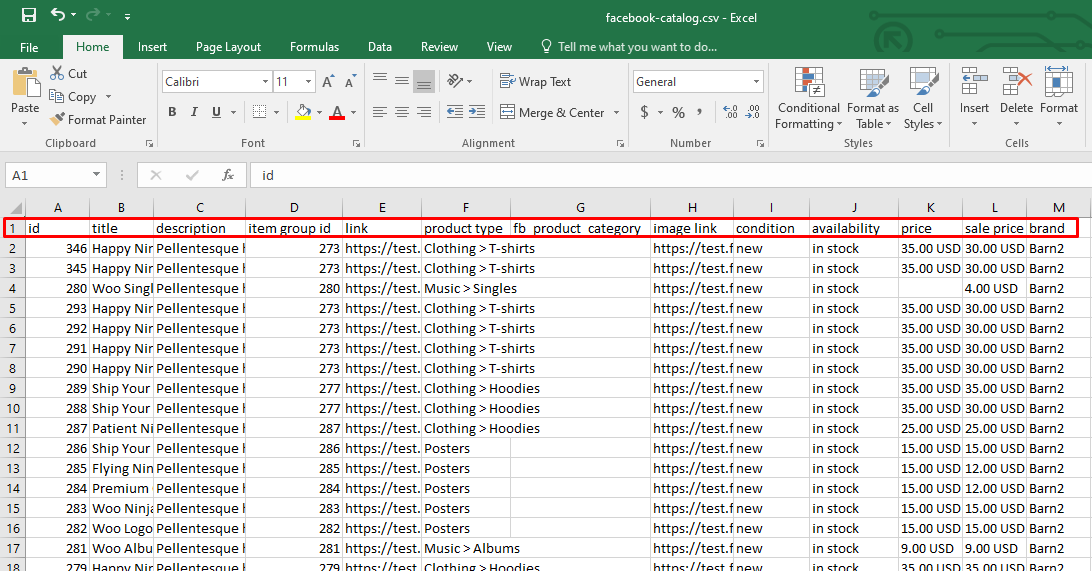
The red-marked column headers are the characteristics of your WooCommerce products. Under them are the values for each product.
The most popular formats are CSV and XML product feeds.
You then need to upload this file to the Meta Catalog manager. We will walk you through the steps later in the article.
Before we go there, let’s find out the Facebook product data feed template requirements.
Facebook Product Feed Required Fields & Attributes (2026)
Every Facebook product feed must include a specific set of required attributes. Missing any required field will cause your products to be rejected by Meta Commerce Manager.
Core Required Fields (All Product Types)
| Attribute | Status | Format / Example | Notes |
|---|---|---|---|
id | Required | SKU001 or 12345 | Unique product identifier. Max 100 chars. Must not change. |
title | Required | Blue Running Shoes - Men's Size 10 | Max 150 chars. Include key attributes (color, size, brand). |
description | Required | Lightweight men's running shoe... | Max 9,999 chars. Plain text only, no HTML. |
availability | Required | in stock | Accepted values: in stock, out of stock, preorder, available for order, discontinued |
condition | Required | new | Accepted values: new, refurbished, used |
price | Required | 59.99 USD | Format: AMOUNT CURRENCY. Must match your website price. |
link | Required | https://yourstore.com/product-page | Full URL to the product page. Must use https. |
image_link | Required | https://yourstore.com/img/shoe.jpg | Min 500×500px. Recommended: 1024×1024px. No watermarks. |
brand | Required | Nike | Required if GTIN is not provided. Max 70 chars. |
Strongly Recommended Fields
| Attribute | Status | Format / Example | Why Include It |
|---|---|---|---|
gtin | Recommended | 012345678901 | Barcode (UPC, EAN, ISBN). Improves ad performance significantly. |
mpn | Recommended | MFR-SKU-001 | Manufacturer Part Number. Use if no GTIN. |
google_product_category | Recommended | Apparel & Accessories > Shoes | Improves ad targeting. Use Google’s official taxonomy. |
sale_price | Recommended | 39.99 USD | Shows strikethrough pricing in ads. |
additional_image_link | Optional | https://yourstore.com/img/shoe-alt.jpg | Up to 20 extra images per product. |
item_group_id | Recommended | SHOE-BLUE-GROUP | Groups product variants (size, color). Required for variant products. |
Additional Required Fields for Apparel Products
| Attribute | Status | Accepted Values |
|---|---|---|
gender | Required (Apparel) | male, female, unisex |
age_group | Required (Apparel) | adult, teen, kids, toddler, infant, newborn |
color | Required (Apparel) | Blue, Red/White (up to 3, separated by /) |
size | Required (Apparel) | S, M, L, 10, 42 |
Feed Formats: CSV vs TSV vs XML — Which Should You Use?
Facebook supports three file formats for your product feed. Here’s when to use each:
| Format | Best For | Pros | Cons |
|---|---|---|---|
| CSV | Beginners, small catalogs | Easy to open in Excel/Sheets. Simple structure. | Commas in product data need careful escaping. |
| TSV | Catalogs with commas in text | Avoids CSV quoting issues. Spreadsheet-friendly. | Less commonly used; slightly harder to read. |
| XML | Large catalogs, developers, automation | Handles complex data. Self-documenting structure. Best for programmatic generation. | Harder to edit manually. Requires valid XML syntax. |
💡 Recommendation: If you use CTX Feed for WooCommerce, choose XML — it handles all formatting automatically and is the most reliable format for large catalogs. For manual editing in Excel/Google Sheets, choose CSV.
Facebook Product Feed CSV Template & Example
Below is a ready-to-use Facebook product feed CSV template with sample data. Copy this into a spreadsheet application like Google Sheets or Microsoft Excel, replace the sample rows with your real product data, and save as .csv.
Facebook Product Feed CSV Template (Copy-Paste Ready)
# Facebook Product Feed CSV Template — WebAppick.com
# Required columns are marked with * in the description above
# Save this file as UTF-8 encoded CSV

id,title,description,availability,condition,price,link,image_link,brand,gtin,mpn,google_product_category,item_group_id,color,size,gender,age_group,sale_price,additional_image_link

SKU001,"Men's Blue Running Shoes","Lightweight and breathable men's running shoes. Ideal for road running and gym training. Available in multiple colors and sizes.","in stock","new","59.99 USD","https://yourstore.com/mens-blue-running-shoes","https://yourstore.com/images/blue-shoes-main.jpg","YourBrand","012345678901","BRAND-SKU001","Sporting Goods > Outdoor Recreation > Outdoor Clothing > Outdoor Footwear","SHOE-BLUE","Blue","10","male","adult","39.99 USD","https://yourstore.com/images/blue-shoes-alt.jpg"

SKU002,"Men's Red Running Shoes","Lightweight and breathable men's running shoes in vibrant red. Same model as SKU001.","in stock","new","59.99 USD","https://yourstore.com/mens-red-running-shoes","https://yourstore.com/images/red-shoes-main.jpg","YourBrand","012345678902","BRAND-SKU002","Sporting Goods > Outdoor Recreation > Outdoor Clothing > Outdoor Footwear","SHOE-RED","Red","10","male","adult","","https://yourstore.com/images/red-shoes-alt.jpg"

SKU003,"Women's Yoga Leggings","High-waist compression yoga leggings for women. 4-way stretch fabric. Moisture-wicking.","in stock","new","34.99 USD","https://yourstore.com/womens-yoga-leggings","https://yourstore.com/images/yoga-leggings.jpg","YourBrand","","BRAND-SKU003","Apparel & Accessories > Clothing > Pants","LEGGINGS-BLK","Black","M","female","adult","","https://yourstore.com/images/yoga-leggings-back.jpg"
✅ Template tips:
- Wrap any value containing a comma in double quotes:
"Men's Shoes, Blue"- The
priceformat must beNUMBER CURRENCY— e.g.,59.99 USD- Availability must be exactly:
in stockorout of stock(lowercase, with space)- Use the full
https://URL forlinkandimage_link- Leave optional fields blank — don’t delete the column headers
Facebook Product Feed XML Example (Copy-Paste Ready)
Here is a complete Facebook product feed XML example following the RSS 2.0 format that Meta Commerce Manager accepts. This is the most widely used XML format for Facebook catalog feeds.
<?xml version="1.0" encoding="UTF-8"?>
<rss xmlns:g="http://base.google.com/ns/1.0" version="2.0">
  <channel>
    <title>Your Store Name</title>
    <link>https://yourstore.com</link>
    <description>Your WooCommerce store product feed</description>

    <!-- ═══ PRODUCT 1 ═══ -->
    <item>
      <g:id>SKU001</g:id>
      <g:title>Men's Blue Running Shoes</g:title>
      <g:description>Lightweight and breathable men's running shoes. Ideal for road running and gym training.</g:description>
      <g:link>https://yourstore.com/mens-blue-running-shoes</g:link>
      <g:image_link>https://yourstore.com/images/blue-shoes-main.jpg</g:image_link>
      <g:additional_image_link>https://yourstore.com/images/blue-shoes-side.jpg</g:additional_image_link>
      <g:availability>in stock</g:availability>
      <g:condition>new</g:condition>
      <g:price>59.99 USD</g:price>
      <g:sale_price>39.99 USD</g:sale_price>
      <g:brand>YourBrand</g:brand>
      <g:gtin>012345678901</g:gtin>
      <g:mpn>BRAND-SKU001</g:mpn>
      <g:google_product_category>Sporting Goods > Outdoor Recreation > Outdoor Clothing > Outdoor Footwear</g:google_product_category>
      <g:item_group_id>SHOE-BLUE</g:item_group_id>
      <g:color>Blue</g:color>
      <g:size>10</g:size>
      <g:gender>male</g:gender>
      <g:age_group>adult</g:age_group>
    </item>

    <!-- ═══ PRODUCT 2 ═══ -->
    <item>
      <g:id>SKU002</g:id>
      <g:title>Women's Yoga Leggings — Black</g:title>
      <g:description>High-waist compression yoga leggings for women. 4-way stretch, moisture-wicking fabric.</g:description>
      <g:link>https://yourstore.com/womens-yoga-leggings</g:link>
      <g:image_link>https://yourstore.com/images/yoga-leggings.jpg</g:image_link>
      <g:availability>in stock</g:availability>
      <g:condition>new</g:condition>
      <g:price>34.99 USD</g:price>
      <g:brand>YourBrand</g:brand>
      <g:google_product_category>Apparel & Accessories > Clothing > Pants</g:google_product_category>
      <g:item_group_id>LEGGINGS-BLK</g:item_group_id>
      <g:color>Black</g:color>
      <g:size>M</g:size>
      <g:gender>female</g:gender>
      <g:age_group>adult</g:age_group>
    </item>

  </channel>
</rss>
⚠️ XML Format Notes:
- Always use
<g:namespace prefix — this is what Meta Commerce Manager expects- Escape special characters:
&for &,<for <,>for >- The file must be valid XML — one malformed tag can break the entire feed
- Use UTF-8 encoding to support special characters and international languages
Facebook Marketplace Bulk Upload Template
If you want to list products on Facebook Marketplace in bulk — rather than one by one — you need a Facebook Marketplace bulk upload template in CSV format. This is different from the catalog feed for ads; Marketplace has its own specific requirements.
Facebook Marketplace CSV Template Format
The Facebook Marketplace CSV template uses a similar structure to the catalog feed but with some key differences — particularly the category field format and location data:
# Facebook Marketplace Bulk Upload CSV Template
# Categories must use Facebook Marketplace's own category IDs
# Location fields are required for local listing

title,description,price,currency,category,condition,availability,link,image_url_1,image_url_2,brand,custom_label_0

"Men's Blue Running Shoes","Lightweight running shoes, barely used. Great condition.","45","USD","Clothing & Accessories > Shoes","used","in stock","https://yourstore.com/shoes","https://yourstore.com/img/shoe1.jpg","https://yourstore.com/img/shoe2.jpg","Nike","summer-sale"
"Yoga Mat - Purple","Non-slip yoga mat. 6mm thick. Includes carrying strap.","25","USD","Sports & Outdoors > Yoga & Pilates","new","in stock","https://yourstore.com/yoga-mat","https://yourstore.com/img/yoga-mat.jpg","","LifeFit","clearance"
Key Differences: Marketplace vs. Catalog Feed Template
| Feature | Catalog Feed (Ads & Shop) | Marketplace Bulk Upload |
|---|---|---|
| Primary use | Dynamic Ads, Facebook Shop, Instagram Shopping | Listing items for sale in Marketplace |
| Upload location | Meta Commerce Manager > Catalogs | Marketplace Manager or Commerce Manager |
| Category format | Google taxonomy or Facebook taxonomy | Facebook Marketplace category hierarchy |
| Requires brand/GTIN | Yes (strongly recommended) | No (optional) |
| Location fields | Not required | Required for local listings |
💡 Tip for WooCommerce stores: Use CTX Feed to generate your catalog feed for Facebook Shop and Dynamic Ads. For Marketplace listings, you can export your WooCommerce products as CSV and reformat the columns to match the Marketplace template above.
How to Download the Facebook Feed Template from Meta?
Meta Commerce Manager provides an official Facebook product feed template download in both CSV and XLSX formats. Here’s how to access it:
- Log in to Meta Commerce Manager at business.facebook.com/commerce
- Click Catalog in the left menu, then select Data Sources
- Click Add Items, then select Data Feed
- On the upload page, click “Download a template.”
- Choose your template type — you can select a niche-specific template (e.g., Apparel, Electronics) from the Custom Template menu for pre-filled category-specific attributes
The downloaded template is a blank CSV or XLSX file with all required column headers pre-filled. You can open it in Excel or Google Sheets, fill in your product data, and upload it back to Commerce Manager.
⚠️ Important: Manually filling in the template is practical for small stores (under 50 products). For larger WooCommerce stores, this manual process is error-prone and time-consuming. The next section covers the automated approach.
How to Create a Facebook Product Feed with CTX Feed (WooCommerce)?
For WooCommerce stores, the best way to generate a Facebook product feed is with Product Feed Manager for WooCommerce – CTX Feed. It eliminates manual data entry by automatically pulling all your product data into a properly formatted feed file.
Here’s the step-by-step process:
Step 1: Install CTX Feed
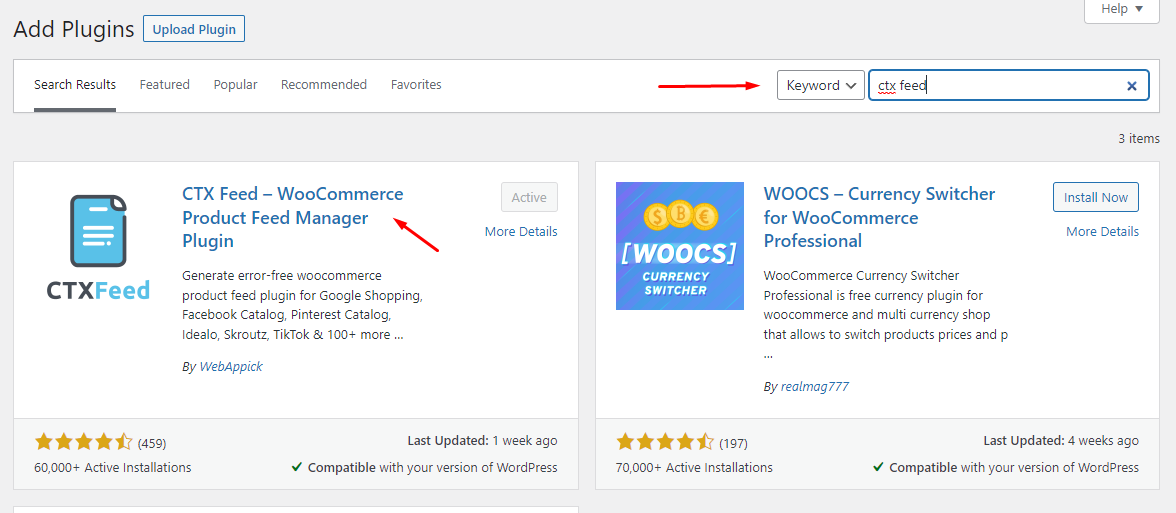
Install CTX Feed from the WordPress plugin repository (free version available). Go to Plugins → Add New and search for “CTX Feed”. Activate the plugin after installation.
Step 2: Create a New Feed
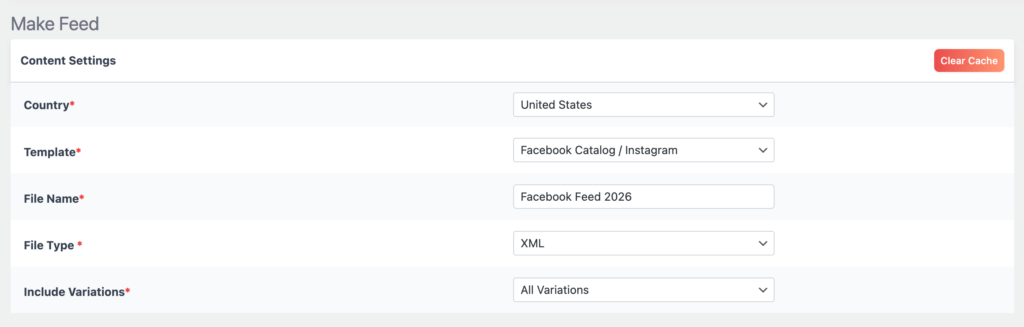
Navigate to CTX Feed → Make Feed. You’ll see the feed creation window. Fill in:
- Feed Name: e.g., “Facebook Feed 2026.”
- Country: select your target country
- Template: select Facebook / Instagram from the dropdown
- File Type: select XML (recommended) or CSV
Step 3: Review Auto-Generated Attributes
Once you select the Facebook template, CTX Feed automatically populates all the required and recommended attributes at the bottom of the screen.
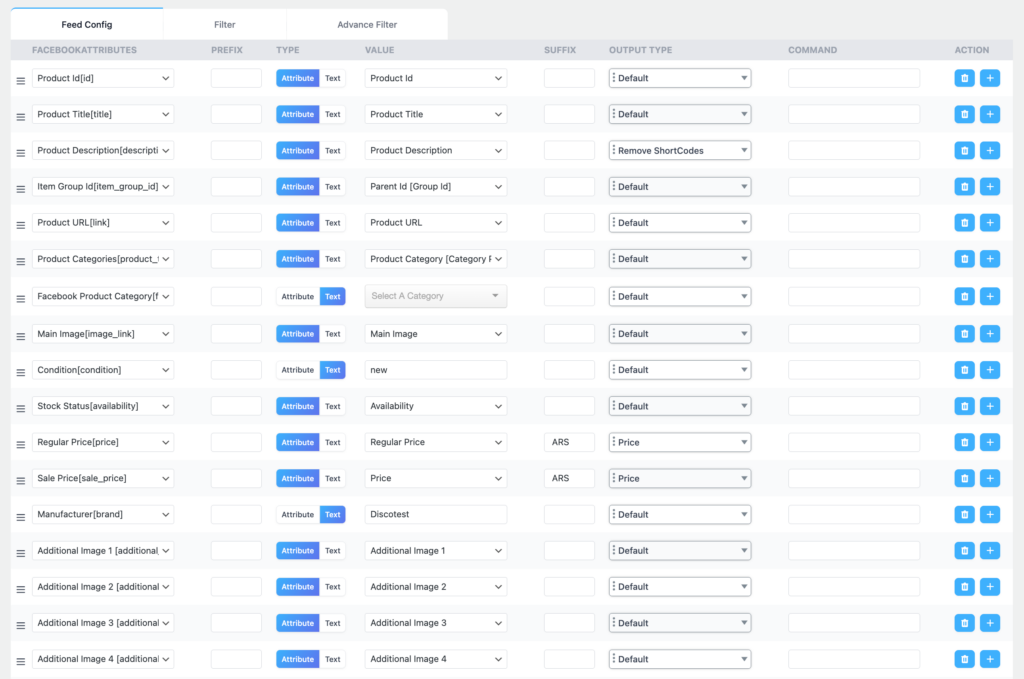
You don’t need to add them manually. Review and adjust if needed — for example, set your brand name for the Brand attribute.
Step 4: Handle Custom Fields (GTIN, Brand, MPN)
Some attributes like GTIN, Brand, and MPN don’t exist as native WooCommerce fields. CTX Feed adds these as custom fields you can enable from Settings → Custom Fields.
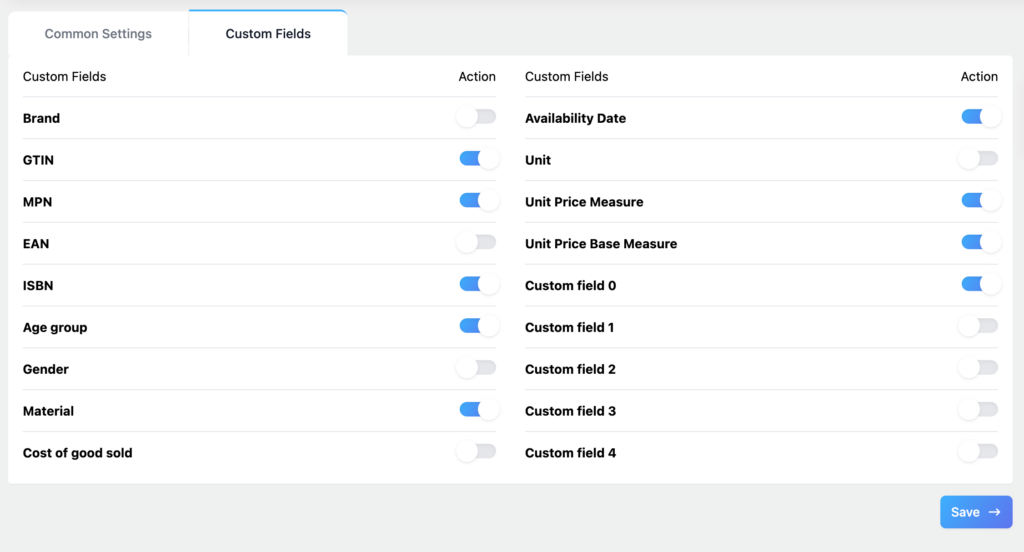
Toggle on Brand and GTIN, then go to any product page and fill in the values under Product Data → Inventory → Custom Fields by CTX Feed.
Step 5: Generate the Feed
Click Save and Generate Feed. CTX Feed pulls all your WooCommerce product data and creates a properly formatted feed file. You can also set an update interval (hourly, every 6 hours, etc.) so the feed stays current automatically.
Step 6: Get Your Feed URL
Go to CTX Feed → Manage Feeds and copy the URL for your Facebook feed. You’ll use this in the next step when uploading to Meta Commerce Manager.
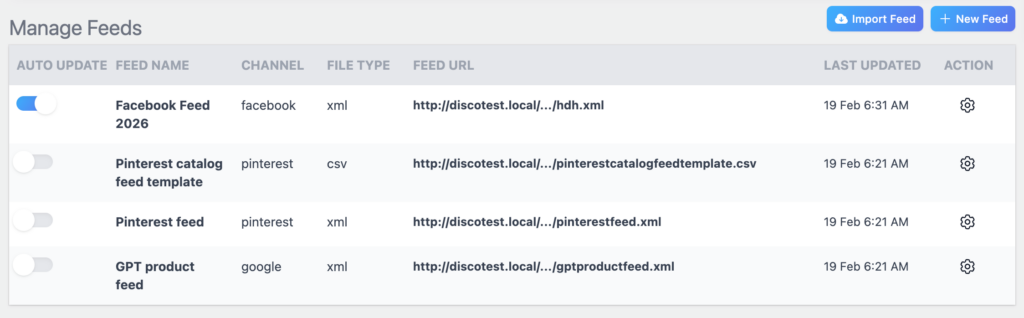
Here is a full guide on how to generate a Facebook Product Feed in WooCommerce
How to Upload Your Feed to Meta Commerce Manager (2026)
Once your feed file is ready, here’s how to connect it to Meta Commerce Manager:
- Go to business.facebook.com/commerce and log in.
- Click Get Started and select Create a Catalog. Choose E-commerce and click Next.
- Select Upload Product Info and click Create. Your empty catalog is now ready.
- Go to Catalog → Data Sources → Data Feed and click Next.
- Select Use a URL (strongly recommended over file upload — it allows Meta to fetch updates automatically).
- Paste your CTX Feed URL into the URL box.
- Set a Fetch Frequency — Hourly is recommended for stores that update prices or stock regularly.
- Give your feed a name and set the default currency. Click Upload.
✅ URL Connection vs. File Upload
Always use the URL connection method rather than manually uploading a file. With URL connection, Meta automatically re-fetches your feed at the scheduled frequency — so price changes, stock updates, and new products are reflected in your catalog without any manual action on your part.
Understanding Fetch Frequency vs. Update Interval
There are two separate refresh cycles to understand:
- CTX Feed Update Interval — how often CTX Feed regenerates your feed file from your live WooCommerce store data (configurable from 1 hour to 1 week; every 5-30 minutes in Pro)
- Meta Fetch Frequency — how often Meta Commerce Manager re-fetches the feed URL to update your catalog
Best practice: set CTX Feed to update more frequently than Meta’s fetch frequency. For example, CTX Feed updates every hour, Meta fetches every 6 hours — so Meta always gets a fresh feed.
Common Facebook Feed Errors & How to Fix Them?
If your Facebook product feed is rejected or showing errors in Commerce Manager, here are the most common issues and their fixes:
| Error | Cause | Fix |
|---|---|---|
| Missing a data feed file | Meta cannot access your feed URL. The file may be blocked, deleted, or the URL changed. | Ensure images are at least 500×500px, hosted on https, and return 200 status. No overlays or watermarks on main image. |
| Invalid availability value | Values like “In Stock”, “Yes”, or “TRUE” are not accepted. | Use exact values: in stock, out of stock, preorder, available for order, or discontinued (lowercase). |
| Price format error | Replace & with &, < with <, > within your XML feed. | Use format: 59.99 USD. Currency code must be ISO 4217 (USD, EUR, GBP, etc.). |
| Image URL rejected | Image is too small, contains a watermark, or URL returns a redirect/error. | Price formatted as $59.99 or 59.99 without a currency code. |
| Missing required field | A required attribute column is blank or missing from the feed. | Check for empty id, title, price, availability, condition, link, image_link, or brand fields. |
| Duplicate ID error | Two or more products share the same id value. | Each product must have a unique ID. Check for duplicates in your WooCommerce product IDs or SKUs. |
| Invalid XML — feed fails to parse | Special characters (&, <, >) in product data are not escaped. | Ensure images are at least 500×500px, hosted on https, and return 200 status. No overlays or watermarks on the main image. |
| GTIN invalid | Verify GTINs are correct (UPC/EAN/ISBN). If your products don’t have GTINs, remove the field or leave it blank, and ensure brand + mpn are present. | GTIN value doesn’t match a real product in the GS1 database, or is in the wrong format. |
Facebook Product Feed vs. Google Shopping Feed: Key Differences
If you’re running ads on both Facebook and Google Shopping, you might wonder whether you can use the same feed for both platforms. The short answer: you can use a similar structure, but there are important differences.
| Attribute / Feature | Facebook (Meta) Feed | Google Shopping Feed |
|---|---|---|
| Availability values | in stock, out of stock, preorder | in_stock, out_of_stock, preorder |
| Category attribute name | google_product_category (optional but recommended) | google_product_category (required for many categories) |
| GTIN requirement | Strongly recommended; not strictly required | Required for branded products |
| Image requirements | Min 500×500px; 1:1 or landscape accepted | Min 100×100px (simple products); 250×250px recommended |
| Upload platform | Meta Commerce Manager | Google Merchant Center |
| Same feed usable? | Not directly — availability format differs. Use separate feeds or a plugin like CTX Feed that manages platform-specific formatting automatically. | |
💡 Using CTX Feed for both platforms: CTX Feed supports 130+ channels including both Facebook and Google Shopping. You can create separate feed files for each from the same WooCommerce product data — each automatically formatted to match that platform’s specifications.
Frequently Asked Questions:
What is a Facebook product feed?
A Facebook product feed (also called a Meta product feed or Meta catalog feed) is a structured file — in CSV, TSV, or XML format — that contains all your product data organized under specific attribute columns like id, title, description, price, availability, and image_link. You upload this file to Meta Commerce Manager to list and advertise your products on Facebook and Instagram.
What format does a Facebook product feed use?
Facebook supports three file formats for product feeds: CSV (comma-separated values), TSV (tab-separated values), and XML (RSS 2.0 or Atom 1.0). CSV is the most beginner-friendly format and easiest to edit in Excel or Google Sheets. XML is the most robust for large catalogs and automation. Both are equally accepted by Meta Commerce Manager.
What are the required fields in a Facebook product feed?
The required fields for a standard Facebook product feed are: id, title, description, availability, condition, price, link, image_link, and brand. For apparel products, additional fields like gender, age_group, color, and size are also required. GTIN or MPN is strongly recommended even when not strictly required.
How often does Facebook update the product feed?
Meta Commerce Manager lets you set a fetch frequency — hourly, daily, or weekly — at which it re-fetches your feed URL and updates your catalog. If you use CTX Feed for WooCommerce, you can configure an update interval (as frequent as every 5 minutes in the Pro version) so your feed file is always current before Meta fetches it.
Can I use one feed for both Facebook and Instagram?
Yes. Facebook and Instagram share the same Meta Commerce Manager platform. A single product feed uploaded to Meta Commerce Manager automatically becomes available for both Facebook Shop and Instagram Shopping. You only need to create one feed file and upload it once.
How do I fix the “missing a data feed file” error on Facebook?
The “missing a data feed file” error usually means Facebook cannot access your feed URL, the file was deleted, or the URL returned an error. To fix it: (1) verify your feed URL is publicly accessible by opening it in an incognito browser, (2) check that your hosting/server is not blocking the feed URL with authentication or a firewall, (3) regenerate the feed file from CTX Feed and update the URL in Commerce Manager if it has changed, (4) ensure the file is in a supported format (CSV, TSV, or XML).
What is the difference between a Facebook product feed and a Google Shopping feed?
Both use similar attribute structures, but they have key differences. Facebook uses in stock (with space) for availability while Google uses in_stock (with underscore). Google requires GTIN for branded products more strictly than Facebook. They are uploaded to different platforms — Meta Commerce Manager for Facebook, Google Merchant Center for Google Shopping. It’s best practice to maintain separate optimized feed files for each platform.
Wrap up
Facebook itself prioritizes eCommerce product promotions on the platform. It has several eCommerce features that can help you reach an incredible number of audiences and drive them to your WooCommerce site.
We hope this article on Facebook product feed template will give a clear picture of how the feed files work and how to generate and utilize them to boost your business growth.