To upload products to Google Merchant Center (GMC), you can add items manually, use a Google Sheets feed, upload a CSV/XML product data feed, connect via platform sync, or use a WooCommerce product feed plugin. Each method relies on accurate product attributes such as title, description, price, availability, and unique identifiers (GTIN/MPN) defined by Google’s latest product data specifications.
In this guide, you will find 7 modern ways to submit your product catalog, along with troubleshooting steps to keep your listings optimized for Shopping ads and free product listings.
Which Upload Method Should You Choose?
Before selecting a method, think about your catalog size, how often your product data changes, and how much control you need over the feed. Some stores only need a simple manual upload, while others need a fully automated product feed using Google Sheets, scheduled fetch, platform sync, a WooCommerce product feed plugin, or API-based upload.
| Upload Method | Best For | Recommended For |
|---|---|---|
| Manual upload | Very small catalogs | Stores with 1–10 products |
| Google Sheets feed | Easy product data editing | Small to mid-sized stores |
| CSV/XML/TXT feed | Bulk product upload | Medium to large catalogs |
| Scheduled fetch | Auto-updating feed URL | Stores with frequent price or stock changes |
| Platform sync | Shopify, WooCommerce, BigCommerce, and other platforms | E-commerce stores that want automatic syncing |
| WooCommerce product feed plugin | Creating Google Shopping feeds from WooCommerce | WooCommerce stores that want automated feed generation |
| API upload | Large or dynamic product catalogs | Developers, marketplaces, and enterprise stores |
For most small stores, manual upload or Google Sheets is enough. For growing e-commerce stores, a CSV/XML feed, scheduled fetch, platform sync, or WooCommerce product feed plugin is usually better. For large stores with constantly changing product data, API-based upload is the most scalable option.
What to Set Up Before Uploading Products
Before you dive into feed creation and uploading, ensure your Merchant Center account and store are ready:
- Account setup: You must have a valid GMC account linked to a Google account.
- Website verification & domain claim: Your online store’s domain must be verified and claimed in GMC so that product landing page URLs match.
- Business information: Complete business info, shipping/tax settings, and return policies as required by Google.
- If using ads: Link your GMC account to Google Ads (for Shopping or Performance Max campaigns).
Once those are in place, you’re ready to build and upload your product catalog.
Product Data Specification: Key Attributes You Need
Whether you use a manual spreadsheet or a real-time API, every product must conform to Google’s product data specifications. Missing core attributes will result in immediate item disapprovals.
Required Product Attributes
At a minimum, every retail product requires:
- id: The unique identifier or SKU for the product.
- title: A concise, accurate name of your product.
- description: Detailed text explaining the product’s features.
- link: The exact landing page URL on your verified website.
- image_link: The URL of your main, high-resolution product image.
- price: The cost including currency (e.g., 29.99 USD).
- availability: Current stock status (in_stock, out_of_stock, or preorder).
- condition: The state of the item (new, used, or refurbished).
Brand, GTIN, and MPN Requirements
Unique Product Identifiers (UPIs) are critical. Google uses them to understand exactly what you are selling and match your items with relevant search queries.
- GTIN: Provide a valid Global Trade Item Number (UPC, EAN, JAN, or ISBN) if the product is mass-manufactured.
- MPN + Brand: If a product does not have a GTIN, provide the Manufacturer Part Number combined with the Brand name.
- Custom Products: For handmade, custom, or private-label goods without identifiers, set the identifier_exists attribute to false. Do not input fake or random numbers, as this triggers severe feed penalties.
Recommended & Optional Attributes
To gain a competitive edge in search rankings, include:
- additional_image_link: Alternative angles or product variations.
- sale_price & sale_price_effective_date: To display promotional strikethrough pricing.
- product_type: Your internal product categorization to help organize campaigns.
- google_product_category: Matching your product to Google’s official taxonomy.
- custom_label_0 to 4: Custom tags used to group products for ad bidding strategies.
7 Modern Ways to Upload Products to GMC
Method 1: Manual Single-Product Upload (Use for Very Small Catalogs)
If you have only a handful of products:
- Log in to your GMC account
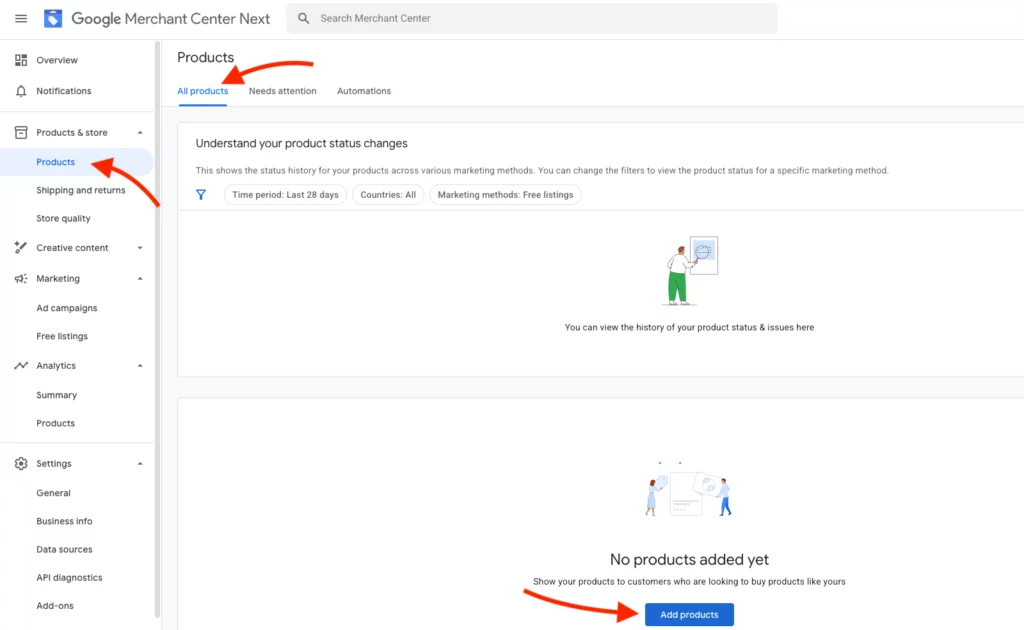
- Navigate to Products → All Products → Add product
- Fill out the required product fields manually (title, price, link, image, etc.)
- Save product will go into review/processing
Method 2: File Upload TXT / TSV / CSV / XML Feed
Most common method for medium-to-large catalogs:
- Create a product feed file in .txt (tab-delimited), .tsv, or .xml format, conforming to Google’s spec.
- In GMC, go to Products → Data Sources (Feeds) → “Add products from a file.”
- Upload the file (up to 4 GB) or host it and use scheduled fetch to have Google automatically import updates.
File feeds are ideal when you export your catalog from a PIM / ERP / marketplace backend or manage via spreadsheets.
Method 3: Google Sheets Live Synced Spreadsheet Feed
If you prefer spreadsheets and frequent editing:
- Use GMC’s “Google Sheets” feed option. Google provides a template to download.
- Fill in product data (id, title, description, price, link, image, etc.) according to template guidelines
- Set a fetch schedule (e.g., daily) Google will periodically sync the sheet, so changes reflect automatically
This method combines ease of editing with near-automated synchronization and is especially handy for small- to mid-sized catalogs or those who prefer spreadsheet management.
Method 4: Scheduled Fetch from Hosted Feed URL
Good for dynamically generated feeds or store back-ends that auto-generate feed files:
- Host your feed file (TXT/TSV/XML) on a public or authenticated URL (HTTP, HTTPS, FTP, SFTP are supported)
- In GMC, add a data source → choose Scheduled Fetch → provide the URL, credentials (if needed), fetch schedule, and time zone
- Google will periodically fetch and update your catalog accordingly
This method reduces manual workload when you upload products to Google Merchant Center and supports frequent updates, which is critical for price- and stock-sensitive products.
Method 5: Automatic Sync via E-commerce Platforms
For many merchants, the simplest route is using platform integrations:
- Platforms like Shopify, WooCommerce, BigCommerce, etc., often offer an official “Google channel” or plugin that connects to GMC. When configured properly, they sync product data (title, price, images, inventory) automatically.
- Once connected, new products or changes to existing ones flow automatically to Google Merchant Center, usually within 24–48 hours.
This is often the easiest and most maintenance-free method for e-commerce stores, especially for small/medium catalogs.
Method 6: Upload Products Using a WooCommerce Product Feed Plugin
If you are using WooCommerce, one of the easiest ways to upload products to Google Merchant Center is by using a WooCommerce product feed plugin like CTX Feed.
A product feed plugin automatically generates a Google Merchant Center product feed from your WooCommerce store and maps store data with Google’s required and recommended attributes, including product identifiers, pricing, availability, categories, images, and sale details.
This method is useful because Google Merchant Center needs accurate product data to approve your listings. If your feed is missing required attributes, has the wrong price, uses invalid GTIN/MPN values, or contains broken image links, your products may get disapproved or receive feed warnings.
With this Feed Plugin, you can create a Google Shopping product feed for WooCommerce and submit it to Google Merchant Center using a feed URL or scheduled fetch.
Here’s how it usually works:
- Install and activate the WooCommerce product feed plugin
- Select Google Shopping or Google Merchant Center as the feed template
- Choose your country, language, currency, and product categories
- Map WooCommerce product fields with Google’s required product attributes
- Generate the product feed in XML, CSV, TXT, or TSV format
- Copy the feed URL
- Go to Google Merchant Center
- Add the feed URL using scheduled fetch
- Let Google fetch and process your WooCommerce products automatically
This is a better option than manual upload if your store has many products or if your prices and stock change frequently.
A plugin-based product feed also helps you update product data automatically, reduce manual work, and keep your WooCommerce product information synced with Google Merchant Center.
Method 7: API-Based Upload Content API for Shopping / Merchant API
For developers, large inventories, or dynamic catalogs, Google supports API-based feed management to efficiently upload products to Google Merchant Center:
- Use the Content API for Shopping (or the latest Merchant API version) to programmatically create, update, or delete product entries.
- Via API, you can send ProductInput resources, including all required product attributes; changes via API are processed in GMC as with manual/ feed-based entries.
- For ongoing operations, supplemental feeds (partial updates) are supported useful if you only need to update price, availability, or other frequently changing attributes without re-uploading all data.
API-based upload is ideal for large catalogs, frequent stock/price changes, or when integrating with backend systems.
Common Issues & Troubleshooting (2026)
Even with the correct format, many uploads still run into issues when you upload products to Google Merchant Center. Here are common problems and how to address them:
GTIN / Identifier Errors
If your feed lacks valid product identifiers such as GTIN, MPN, or brand, products may be disapproved or get limited visibility.
Always use correct identifiers. If you sell handmade, custom, private-label, or unbranded products, provide identifier information carefully based on the product type.
Avoid using fake GTINs or random MPN values because this can create feed errors and reduce trust in your product data.
Price & Availability Mismatch
If the price or availability in your feed doesn’t match the actual product page on your site, especially if you update the price or stock Google may disapprove or hide products.
Use frequent updates through Google Sheets, scheduled fetch, API sync, or automated platform integration to keep product data consistent.
Image Issues
Low-quality images, missing images, broken image URLs, or images with watermarks/overlays can trigger disapproval or reduce performance.
Use clear, high-resolution product images with a clean background. Also include additional_image_link where useful to help shoppers view the product from different angles.
Link Attribute and Landing Page Issues
Your link attribute must point to the correct product landing page.
The product page should be live, crawlable, mobile-friendly, and part of the domain verified in Google Merchant Center.
If the URL is broken, redirects incorrectly, or shows different product information than the feed, Google may flag the item.
Landing Page & Policy Violations
Ensure that your product’s landing page is live, belongs to the domain you verified, and meets Google’s policies for shipping, returns, accurate information, and allowed products.
Invalid URLs or site policy violations can cause disapproval.
Feed Formatting Errors
Even minor formatting mistakes, such as wrong delimiters, missing required fields, incorrect currency format, or invalid XML structure, can break the entire feed.
Always validate your feed before uploading. If using spreadsheet or XML export, check formatting carefully.
Google Merchant Center Website Not Claimed
If your website is not verified and claimed, Google may not approve your product URLs.
Before uploading a product feed, verify and claim your domain in the Merchant Center. This ensures that the submitted product links belong to your business.
Optimization Tips Make Your Feed Better Than Just “Valid”
Uploading a feed properly is only half the battle. To get the most out of GMC and Google Shopping/Ads:
Optimize Product Titles and Descriptions
Include brand, product type, key features, specifications, color, size, material, model, and important shopper keywords where relevant.
For example, instead of a short title like:
Running Shoes
Use a more descriptive title like:
BrandName Men’s Blue Lightweight Running Shoes Size 10
This helps Google understand the product and match it with more relevant search queries.
Use All Recommended Attributes
Additional images, sale_price, sale_price_effective_date, product_type, google_product_category, and custom labels can improve feed quality.
Rich data helps Google match your products to more queries and can improve visibility across Shopping results and free listings.
Keep Price and Availability Updated
Schedule frequent updates, especially for price, availability, stock, sale price, and fast-changing products.
This helps avoid mismatch issues between your product feed and website.
Use Supplemental Feeds or API for Partial Updates
Supplemental feeds or API updates are helpful when only some fields change often, such as price, stock, sale price, or promotional labels.
This allows you to update selected product data without re-sending the full feed every time.
Monitor Diagnostics & API Logs
Check Merchant Center Diagnostics regularly and fix warnings and errors promptly.
A clean feed improves eligibility, product approval, and long-term visibility.
Frequently Asked Questions
What attributes are required for Google Merchant Center?
The most common required attributes are id, title, description, link, image_link, price, availability, condition, brand, GTIN, and MPN. Some product categories may need extra attributes such as size, color, material, shipping, or google_product_category.
Can I upload products to Google Merchant Center with Google Sheets?
Yes. You can use Google Sheets as a product feed source in Google Merchant Center. It is useful for small to mid-sized catalogs because you can edit product data in a spreadsheet and let Google sync it.
Can I use a WooCommerce plugin to upload products to Google Merchant Center?
Yes. A WooCommerce product feed plugin can generate a Google Merchant Center feed from your store and submit it using a feed URL or scheduled fetch. This is useful for stores with many products or frequent price and stock changes.
What is the best way to upload bulk products to Google Merchant Center?
For bulk products, the best method is usually a CSV, TXT, TSV, or XML product feed. If your inventory changes often, scheduled fetch, platform sync, or API upload is better.
Why are my products not approved in Google Merchant Center?
Products may not be approved because of missing required attributes, invalid GTIN/MPN/brand values, price or availability mismatch, broken image links, website not claimed, or policy violations.
Final Thought
Uploading your product catalog to Google Merchant Center in 2026 is not just a one-time setup. Your success depends on accurate product data, the right upload method, and regular feed updates.
By following Google’s product data specifications and using the right method, manual upload, Google Sheets, product feed, scheduled fetch, platform sync, WooCommerce plugin, or API, you can keep your products eligible, visible, and competitive across Google Shopping and free product listings.

Free version on WordPress.org. Every Pro licence includes a 30-day money-back guarantee.