
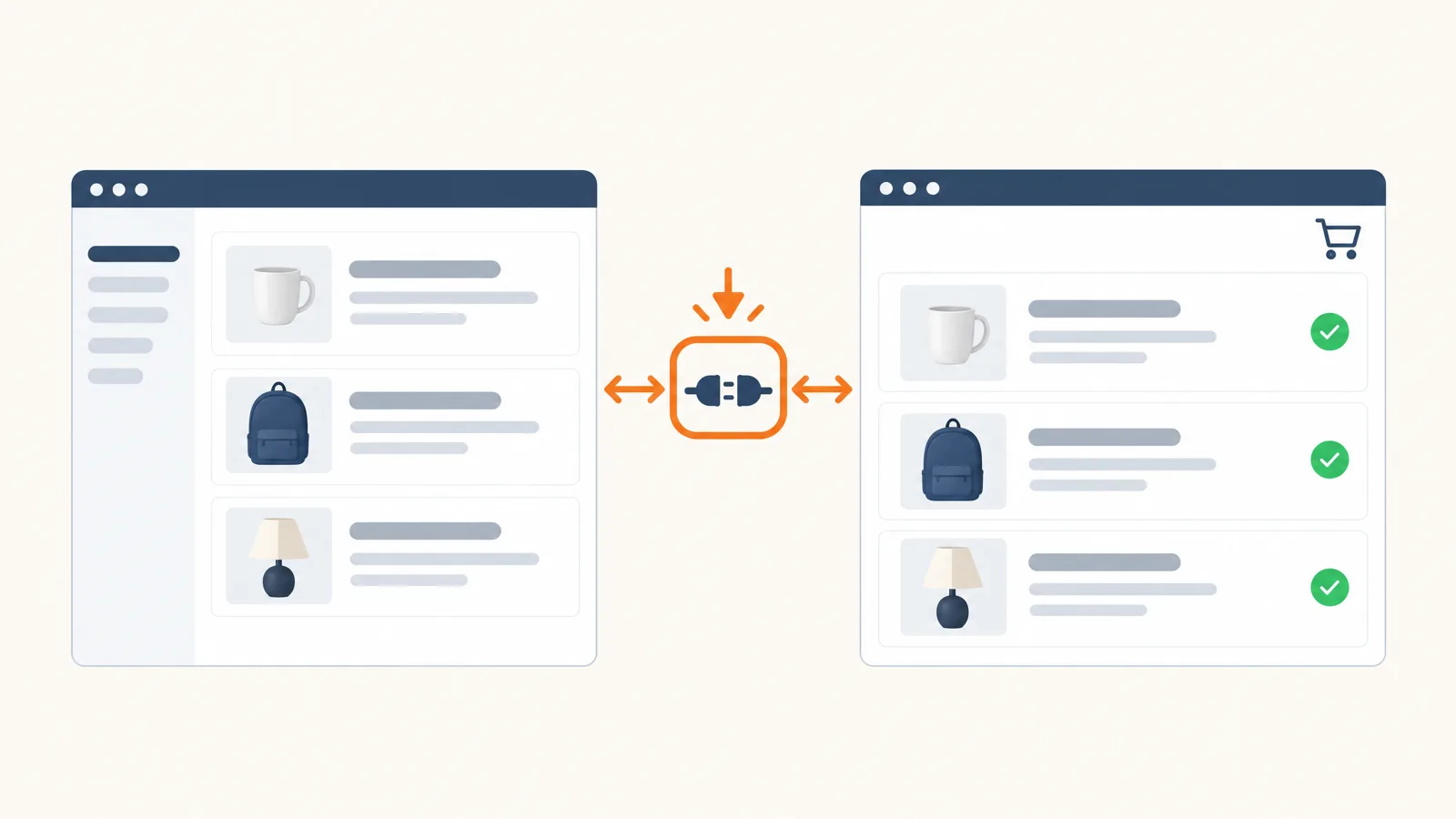
WooCommerce has no built-in Amazon integration: you add a plugin or app that links your store to your Amazon seller account. There are three kinds of “integration”, and they do different jobs:
- List and sync your products on Amazon: your WooCommerce products become Amazon listings, with stock and orders kept in step. This is the route most of this guide covers.
- Let Amazon ship your WooCommerce orders: Amazon Multi-Channel Fulfillment packs and ships orders from your own store.
- Add Amazon affiliate links: you earn on purchases made at Amazon; you don’t sell your own stock.
Pick your route below, check what you need before you connect, then compare the plugins that do it.
How to Connect WooCommerce to Amazon? (3 ways)
1. List and sync your WooCommerce products on Amazon
An integration app creates Amazon listings from your WooCommerce products (or links products you already sell there by SKU or ASIN), keeps stock in sync so you don’t oversell, and brings Amazon orders back into WooCommerce. Amazon describes apps in its Selling Partner Appstore the same way: “software solutions that connect with your selling account”, used to “integrate your business’s site with Amazon for faster listing and cross-channel synching”.
Choose this route if you want Amazon shoppers to buy your products on Amazon. To integrate WooCommerce with Amazon this way, you’ll need a seller account first (next section).
2. Let Amazon ship your WooCommerce orders (Multi-Channel Fulfillment)
This is a different job. If you keep stock in Amazon’s warehouses, Amazon can also ship the orders customers place on your WooCommerce site.
Two Amazon programmes are easy to mix up:
- Fulfillment by Amazon (FBA) handles orders placed on Amazon.
- Multi-Channel Fulfillment (MCF) is the one for your own store: Amazon will “pick, pack, and ship customer orders across all your sales channels”, including your own website.
An MCF plugin sends each paid WooCommerce order to Amazon as a fulfilment order and pulls the stock level back into WooCommerce. You don’t sell these products to Amazon shoppers, but your stock has to be in Amazon’s fulfilment centres first, and each WooCommerce SKU must match its Seller SKU there.
3. Add Amazon affiliate links (Amazon Associates)
Amazon Associates is Amazon’s affiliate programme, separate from selling. You link to products on Amazon and “earn money on qualifying purchases”; it’s open to bloggers, publishers and creators “with a qualifying website or mobile app”. Nothing from your own catalog is sold on Amazon, so it only fits stores that also publish content.
Want the opposite, importing Amazon products into WooCommerce? That’s a different job. See How to Add Amazon Products to WooCommerce.
What you need before you connect
Check these three things before you connect.
1. An Amazon seller account, ideally the Professional plan. Amazon has two selling plans: Individual at $0.99 per item sold, and Professional at $39.99 a month plus selling fees. Amazon’s Selling Partner Appstore page says “Access to the Selling Partner Appstore is included for free with a Professional selling account”, and one of the plugins below lists “An Amazon Pro Seller merchant account” as a requirement. If you plan to connect a third-party app, check before you sign up that your plan allows it.
2. Product IDs and category rules. Before you connect, check in Seller Central which product IDs (barcodes) and category approvals your products need, so your first sync doesn’t fail on products Amazon won’t accept.
3. Matching SKUs. If some of your products are already on Amazon, the app needs to match them to your WooCommerce products, by ASIN or SKU, instead of creating duplicate listings. One fulfilment plugin needs your WooCommerce SKUs to match your Amazon seller SKUs. Clean up SKUs in WooCommerce before the first sync.
What changed in 2025: Amazon’s API stopped taking listing feed files
Amazon’s Selling Partner API, the interface integration apps use to connect to your seller account, used to accept product listings as XML and flat-file (spreadsheet-style) feeds. Not any more:
| Amazon feed type (examples) | Deprecated | Removed |
|---|---|---|
POST_PRODUCT_DATA (XML), POST_FLAT_FILE_LISTINGS_DATA, POST_FLAT_FILE_INVLOADER_DATA, POST_FLAT_FILE_PRICEANDQUANTITYONLY_UPDATE_DATA and other XML/flat-file listing feeds | March 18, 2024 | December 3, 2025 |
Source: Amazon’s SP-API deprecation schedule. Amazon’s feed-type reference now says “Feeds API support for XML and flat file product listings feeds is deprecated”, and JSON_LISTINGS_FEED is the only listings feed type left.
What this means for you: before you install an integration, check its last updated date and changelog. A plugin that hasn’t been updated since before December 2025 may still be built on a feed type Amazon no longer accepts. Ask the vendor whether it uses Amazon’s current listings API.
5 Plugins and Apps to Integrate WooCommerce with Amazon
Every fact below is from the plugin’s own listing or vendor page, read on November 6, 2026. Check the page again before you buy: versions and prices change.
| Plugin | Vendor | Lists products on Amazon | Stock sync | Amazon orders into WooCommerce | FBA / MCF | Free plan or trial | Version / last updated |
|---|---|---|---|---|---|---|---|
| Amazon for WooCommerce | CedCommerce | Yes (bulk upload) | Yes | Order tracking listed | Not stated | 7-day free trial | v1.3.1 (date not shown) |
| WP-Lister Lite / Pro for Amazon | WP Lab | Yes | Not stated for Lite; Pro syncs sales | Pro | FBA supported | Free Lite version | v2.9.2.5, Nov 4, 2026 |
| Multichannel for WooCommerce | miniOrange | Yes (bulk) | Premium (scheduled) | Free: manual; Premium: scheduled | FBA and FBM orders | Free + Premium | v2.4.0, Oct 13, 2026 |
| Amazon Fulfillment (MCF) for WooCommerce | Never Settle | No (fulfilment only) | From Amazon stock | Sends orders to Amazon | MCF | $99 (1-year plan) | v4.2.9.12 (date not shown) |
| LitCommerce | LitCommerce | Yes | Yes | Yes | No FBA inventory sync | 7-day free trial; from $29/mo | v1.3.6, Oct 8, 2026 |
1. Amazon for WooCommerce (CedCommerce)
Sold on the WooCommerce Marketplace. It bulk-uploads WooCommerce products to Amazon, uses ASINs and SKUs to match products, and keeps “stock and orders updated automatically to prevent overselling”. Version 1.3.1, with a 7-day free trial. Suits stores that want an extension bought through WooCommerce.com.
2. WP-Lister Lite / Pro for Amazon (WP Lab)
A plugin on WordPress.org: 800+ active installs, version 2.9.2.5, last modified November 4, 2026. The free Lite version lists products (including variations), supports FBA and can import products from Amazon; Pro adds sales and order sync and an automatic repricing tool. Suits stores that want to start free and run everything inside WordPress.
3. Multichannel for WooCommerce – Amazon, eBay and more (miniOrange)
On WordPress.org: 70+ active installs, version 2.4.0, last modified October 13, 2026. The free plan covers product sync, bulk uploads and manual sync of the previous day’s orders; Premium adds scheduled stock and order sync, variation sync and multi-region Amazon sync. It handles both FBA and FBM orders. Suits small catalogs that can live with a manual order step on the free plan.
4. Amazon Fulfillment (MCF) for WooCommerce (Never Settle)
This one doesn’t list anything on Amazon. When a WooCommerce order is paid, it sends the order to Amazon MCF for shipping, and it keeps WooCommerce stock synced from your Amazon inventory. It needs an Amazon Pro Seller account with MCF, and your SKUs must match. Version 4.2.9.12; the 1-year plan was $99 on the listing. Suits stores that already keep stock in Amazon’s warehouses.
5. LitCommerce (multichannel app)
A multichannel service you connect to WooCommerce through its own plugin on WordPress.org (v1.3.6, last modified October 8, 2026). It names WooCommerce as a supported store, creates Amazon listings (as drafts you review first), links existing listings, and syncs listings, orders, pricing and stock between your store and Amazon. Its Amazon page says it “doesn’t support Amazon FBA inventory sync”. A 7-day free trial; the Multichannel plan starts from $29 a month. Suits sellers on several marketplaces at once.
Selling on more marketplaces than Amazon? See our roundup of WooCommerce multichannel selling plugins.
Where CTX Feed fits (and where it doesn’t)
To be clear: CTX Feed doesn’t list or sync products on Amazon. It has no Amazon template. For Amazon, use one of the apps above.
Here’s why a product feed isn’t the answer for Amazon. Google Shopping reads a feed URL your store publishes and re-fetches it on a schedule. Amazon doesn’t work that way: listings go in through Seller Central or an app that connects to your selling account, and the API no longer takes XML or flat-file listing feeds.
Where CTX Feed does help is everywhere else you sell. CTX Feed has ready-made templates for Google Shopping, Meta (Facebook and Instagram), Pinterest, Bing, TikTok and Idealo, and generates those feeds from your WooCommerce catalog:
- 90+ pre-configured channel templates, and you can create feeds for 220+ channels.
- Custom Template 1 for a channel that has no preset.
- XML, CSV, TSV, TXT or JSON output, served at a feed URL the channel downloads.
- Automatic updates on a schedule you choose, so price and stock stay current.
Making a feed is free; no license is needed. For the steps, see how to make a WooCommerce product feed and, if your channel wants a delimited file, how to configure a CSV or TXT feed.
Why sell on Amazon alongside WooCommerce
Your store keeps the customer relationship; Amazon adds a second place to be found. Amazon’s own selling-plan page lists these options:
- Fulfillment by Amazon: Amazon stores and delivers your orders.
- Amazon Ads: advertise your listings (optional, at extra cost).
- Brand tools: enhanced product pages and a digital brand store (you need to enrol your brand in Amazon Brand Registry).
- Amazon Business: sell to business buyers.
- Global Selling: expand to other Amazon marketplaces.
Whether it pays off depends on your margins after Amazon’s fees, so price it on Amazon’s pricing page before you list.
Frequently Asked Questions (FAQs)
Can WooCommerce connect to Amazon?
Yes, through a plugin or app that links your store to your Amazon seller account. WooCommerce has no built-in Amazon connection.
How do I integrate WooCommerce with Amazon?
Pick one of three routes: list and sync your products on Amazon with an integration app; let Amazon ship your WooCommerce orders through Multi-Channel Fulfillment; or add Amazon affiliate links through Amazon Associates. See How to Connect WooCommerce to Amazon for each.
Does Amazon integrate with WordPress?
Through third-party apps. Amazon’s Selling Partner Appstore lists apps that “connect with your selling account”, and Amazon says it reviews all apps when they register and list. Search the Appstore for WooCommerce, or use one of the plugins above.
Can I use a product feed to list my WooCommerce products on Amazon?
Not the way Google Shopping works. Amazon listings go in through Seller Central or an app using Amazon’s API, and Amazon removed XML and flat-file listing feeds from that API on December 3, 2025. Use a product feed for Google, Meta and other feed-based channels.
Do I need a Professional seller account?
To use apps from Amazon’s Selling Partner Appstore, plan on it: Amazon says Appstore access “is included for free with a Professional selling account”, which costs $39.99 a month plus selling fees. Check with your app’s vendor what plan it requires.
How do I import Amazon products into WooCommerce?
That’s the reverse direction: you bring Amazon product data into your store, for affiliate or dropshipping sites. See How to Add Amazon Products to WooCommerce.
What are the benefits of integrating WooCommerce with Amazon?
You manage products, stock and orders from one place instead of updating two catalogs by hand, which cuts the risk of selling something you no longer have. An integration also lets you add Amazon’s services, such as FBA or MCF, without leaving WooCommerce.
Start Connecting your WooCommerce Store to Amazon
- Pick your route: list and sync, Amazon fulfilment, or affiliate links.
- Check your seller plan, product IDs and SKUs.
- Choose a plugin that’s been updated since Amazon’s December 2025 change.
Selling on Google Shopping, Meta or Bing too? Generate those feeds from your WooCommerce store with CTX Feed. The free version is on WordPress.org.

Free version on WordPress.org. Every Pro licence includes a 30-day money-back guarantee.
This article is a game-changer for anyone navigating the world of e-commerce! It brilliantly demystifies WooCommerce Amazon integration, offering a comprehensive guide enriched with plugin insights. An invaluable resource for maximizing the potential of your online store.
Thanks for the kind words!
We’re glad you found the article on WooCommerce Amazon integration helpful.
If you have any more questions, feel free to ask!