Google requires a description for every product in your Merchant Center feed, sent in the description or structured_description attribute. It can be 1 to 5,000 characters. It must describe only the product: no promotional text such as price, shipping or your company name, no links, no comparisons with other products, and no all-caps gimmicks. Put the key details in the first 160–500 characters. If the text was written by generative AI, it belongs in structured_description, not description.
On WooCommerce, don’t type descriptions into a spreadsheet. Generate the feed from your store, so each product’s own description reaches Google, cleaned of HTML and shortcodes. Jump to the WooCommerce setup.
What Is the Google Shopping Description Attribute?
The description attribute is the field in your product data feed that tells shoppers, and Google, what the product is. Google’s product data specification calls it simply “your product’s description”. The title names the product. The description adds what the title can’t fit: material, size, features, what’s in the box, who it’s for.
A description over the limit isn’t rejected: Google truncates it to fit and shows a warning. The field takes Unicode text, and Google recommends ASCII.
Is the Description Attribute Necessary for Google Shopping?
Yes. Google Merchant Center lists description (or structured_description) as required for each product. A product without one gets a warning and may experience limited performance.
So the description isn’t optional polish. It’s a required field, and a good one helps you build complete product listings on Google Shopping.
Google Shopping Description Requirements
These are Google’s rules, taken from its description attribute page, read on 2026-11-16. The table is the short version. The numbered sections below explain the ones people get wrong.
| Rule | What Google says (short) | What to do |
|---|---|---|
| Required | Every product needs a description; a missing one gets a warning | Send a description for every product, variations included |
| Length | 1–5,000 characters; longer text is truncated with a warning | Aim for complete, not long. Key facts first |
| Promotional text | No price, sale price, sale dates, shipping, delivery dates, time-related info or company name | Use price, sale_price and shipping settings for those |
| Links | No links to your store or other websites | Use the link attribute for the product URL |
| Comparisons | No comparisons or details about other products | Describe this product only |
| Capitals | No all caps or symbols as gimmicks; capitals are fine for abbreviations, phone numbers, countries and currency | Write in sentence case |
| Categories | No references to categorization systems | Use google_product_category or product_type |
| Product only | No accessories, compatible or similar products, business history or policies | Leave out returns, warranty boilerplate and “you may also like” |
| Language | Professional and grammatically correct; mostly in the data source’s language; foreign words only if well understood | Write in the language of your feed |
| Consistency | Consistent with the rest of your data (for example, the title) and the landing page | Don’t say “blue” in the description and “navy” on the page |
| Encoding | Use XML entities or escaped characters for symbols; don’t encode twice | Watch for & in your feed |
| AI-written text | Generative-AI descriptions go in structured_description | See AI-written descriptions |
1. Character Limit
The description must be between 1 and 5,000 characters. If it’s longer, Google truncates it to fit and warns you. You won’t be disapproved for length alone, but truncation can cut off the end of the text.
The field accepts Unicode, and Google recommends ASCII characters only. Emojis and decorative symbols also fall under the “gimmicks” rule below.
2. No Promotional Texts
Google’s list of promotional text is broader than most people expect. Leave out the price, sale price, sale dates, shipping, delivery dates, other time-related information and your company’s name. “Free shipping”, “20% off this week” and “Order by Friday for Christmas delivery” all break this rule.
Each of those facts has its own home: price and sale_price for prices, your shipping settings for delivery. Keep the description for the product itself.
3. Using Correct Language
Write in professional, grammatically correct language. Google calls out “gimmicky ways of drawing attention” such as all caps, symbols and promotional text.
Two language rules catch multilingual stores. Most of your product data must be in the language of the data source, and foreign words are fine only when they’re well understood. English marketing slogans in a German feed break two rules at once: foreign words that may not be well understood, and promotional text.
4. Talk Only About the Product
Describe only the product itself. Google lists what doesn’t belong:
- details about compatible products, accessories or similar products;
- your business’s history or policies;
- links to your store or other websites.
So “Fits all our 15-inch laptop sleeves” and “30-day returns, family business since 1998” both come out. Images have their own rules; see Google Shopping image requirements.
5. No Comparison with Other Products
Don’t include comparisons or details about other products. “Lighter than Brand X” or “better than the leading model” break this rule. Describe what your product does, not what it beats.
6. Avoid Categorization References in Product Descriptions
Don’t put category paths such as “Electronics > Computers > Laptops” in the description. Google has separate attributes for that: google_product_category for Google’s own taxonomy and product_type for your store’s categories. See the Google product category guide.
7. Excluding Store Links
Don’t include links to your store or other websites. The product page URL goes in the link attribute, which Google lists as a required field of its own.
8. Bundles, Multipacks and Custom Products
Three cases have their own guidance:
- Bundles and multipacks: describe the entire bundle or multipack. For a multipack, say how many items are sold together (“Pack of 6 cotton crew socks”).
- Customizable products: if a product can be engraved or personalized, add that to the description.
- Variants: each variant can carry its own description. Google’s example for pens keeps the text the same and changes only the variant detail, “Red ink.” versus “Black ink.”
AI-Written Descriptions: Use structured_description
If you bulk-wrote product descriptions with an AI tool, this is the rule that affects you. Google says all descriptions created using generative AI must be sent as structured_description, not description.
structured_description has two sub-attributes:
digital_source_type(optional):default, ortrained_algorithmic_mediafor AI-generated text. If you leave it out,defaultis used.content(required): the description text, 1–5,000 characters.
For AI text, digital_source_type must be trained_algorithmic_media. In an XML feed it looks like this:
<g:structured_description>
  <g:digital_source_type>trained_algorithmic_media</g:digital_source_type>
  <g:content>Merino wool hiking socks with a cushioned sole…</g:content>
</g:structured_description>
In a text (TSV) feed, the two values are separated with a colon: trained_algorithmic_media:"Merino wool hiking socks…". Get that format wrong and Google disapproves the product with “Too many sub-attributes for the attribute”.
If you send both description and structured_description, Google uses only description. Sending both doesn’t label your AI text.
CTX Feed and structured_description: CTX Feed’s Google Shopping attribute list doesn’t include structured_description at the current release (free 8.0.44, Pro 8.0.34). CTX Feed sends your WooCommerce description in description. Google’s rule covers every description created using generative AI and makes no exception for edited AI text, so if your descriptions were generated by AI, have a person write the text you send in description.
How the Description Attribute Fits Into Google Shopping Feed Specifications
The description is one attribute in a larger feed. It should agree with the others, especially the title and the landing page. These are the attributes you’ll meet most often:
| Attribute | What it holds | Google’s label |
|---|---|---|
id | Your product’s unique identifier | Required |
title | The product’s name | Required |
description | The product’s description | Required |
link | The product’s landing page | Required |
image_link | The main product image URL | Required |
availability | Stock status | Required |
price | The product’s price | Required |
brand | The brand name | Required for new products (some exceptions) |
gtin | Global Trade Item Number | It depends (strongly recommended if available) |
google_product_category | Google’s category for the product | Optional |
product_type | The category you define | Optional |
For every attribute, its format and when it’s required, see our Google product feed specifications guide.
How to Send the Right Description From WooCommerce (CTX Feed)
A WooCommerce store shouldn’t keep descriptions in a spreadsheet. A hand-kept sheet goes stale the day you edit a product, needs one row per variation, and has to be re-uploaded after every change. A feed plugin reads the description straight from each product instead.
CTX Feed is a WooCommerce product feed plugin. The free version is on WordPress.org. Its Google Shopping template already maps the required attributes, including description, and it writes the feed as XML, CSV, TSV or TXT. For Google feeds, it cuts the description to Google’s 5,000-character limit.
What matters for the description is which WooCommerce field ends up in the feed and what happens to it on the way. The four sections below cover that. The click-by-click steps are in the linked docs. To build the feed itself, see how to generate a WooCommerce Google Merchant feed or create a Google Shopping feed for WooCommerce.
Plain Text or HTML?
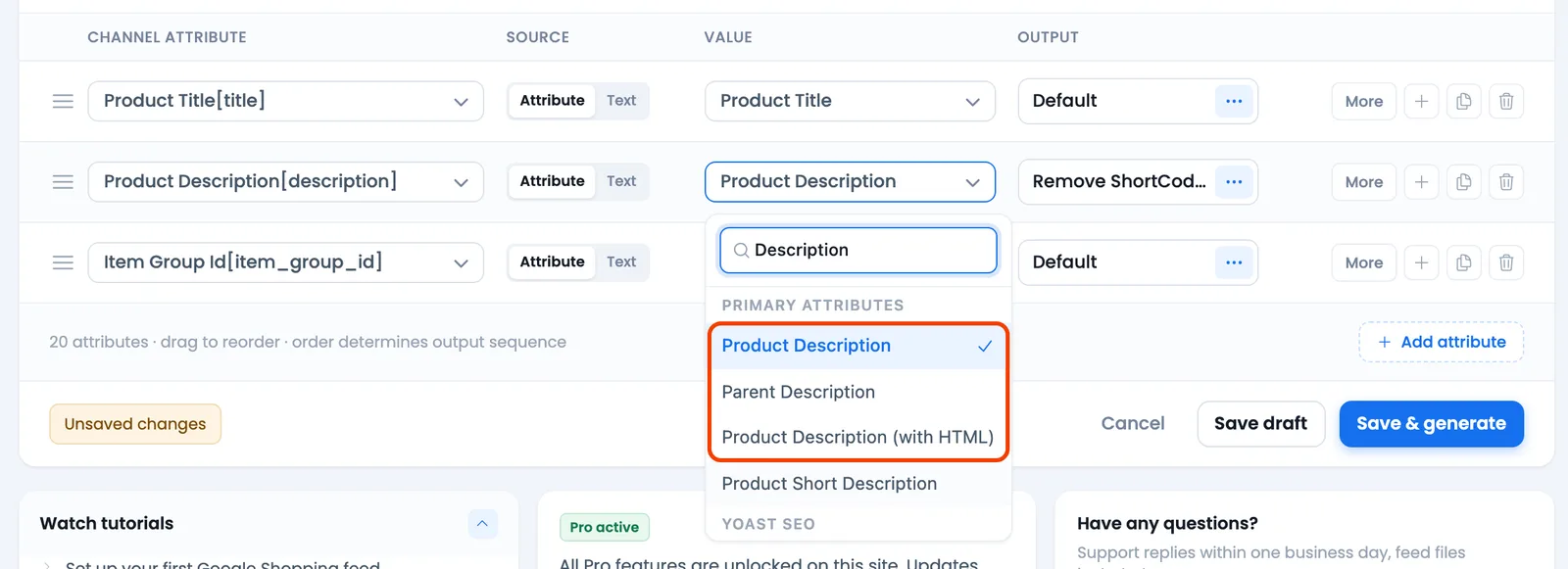
WooCommerce product descriptions are written for your website, so they’re full of HTML: <p>, <strong>, lists. CTX Feed gives you a choice in the description row’s Value dropdown:
| Value | What it sends | Use it for |
|---|---|---|
| Product Description | The long description with HTML tags and shortcodes removed | Google Shopping (the default) |
| Product Description (with HTML) | The description with markup kept; the short description if the long one is empty | Only channels that render HTML |
| Product Short Description | WooCommerce’s short description field | Stores whose short description is the better product summary |
| Parent Description | The parent product’s description, for variations | Variable products (see below) |
Google’s product data specification gives the description’s syntax as plain text. Keep the default Product Description. If you see raw <p> or <br> tags in your listings, the row is mapped to the with-HTML value.
Steps: Product description with or without HTML.
Shortcodes and Page Builders
Page builders and shortcode plugins leave codes like [vc_row] or [su_button] in the description field. Your storefront runs them, so they look fine on the product page. A feed is a data file with no render step, so an unprocessed shortcode goes into the feed as literal text.
What fixes it:
- Free: the plain Product Description value already has shortcodes and HTML removed. The Google Shopping template also sets Remove ShortCodes on the description row. For other text fields, the row’s Output column has Remove ShortCodes and Strip Tags.
- Pro: formatting commands. Remove shortcodes expands the shortcodes still registered on your site, then strips what’s left, including tags from plugins you’ve removed. Follow it with Remove HTML and Trim. Truncate caps the length at a number you choose.
The cleanest long-term fix is at the source: keep the WooCommerce description field itself simple, and use the builder only for the page layout.
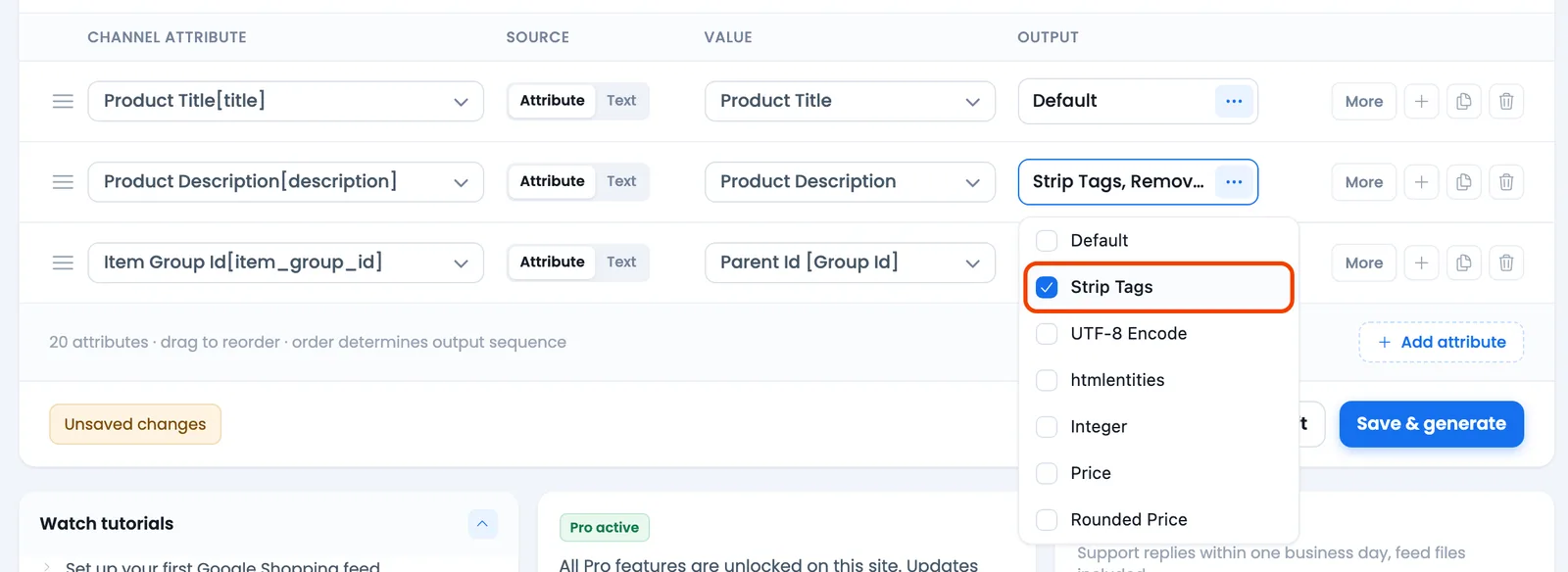
Steps: Remove shortcodes from product description and formatting commands (Pro).
Variations Without Their Own Description
In WooCommerce, each variation has its own description field. If you leave it empty and write the text on the parent product instead, the variation has no description of its own.
CTX Feed handles this by default. When a variation’s description comes out empty, it uses the parent product’s description instead. Two details:
- Only the parent’s long description counts. If variations still come out empty, the parent has no long description; add one.
- To always use the parent’s text, even when a variation has its own, map Parent Description or set the row’s Output to only_parent.

Steps: Add variable product info to variations.
Products With No Description
A product with no description at all gets Google’s missing-description warning. CTX Feed Pro can leave those products out of the feed: turn on Remove no-description products on the Filters tab. For a variation, it drops the row only when both the variation’s and the parent’s descriptions are empty, so a variation that inherits text stays in.
On the free plugin those toggles are shown but locked. The free alternative is to write a description for each product before it goes in the feed.
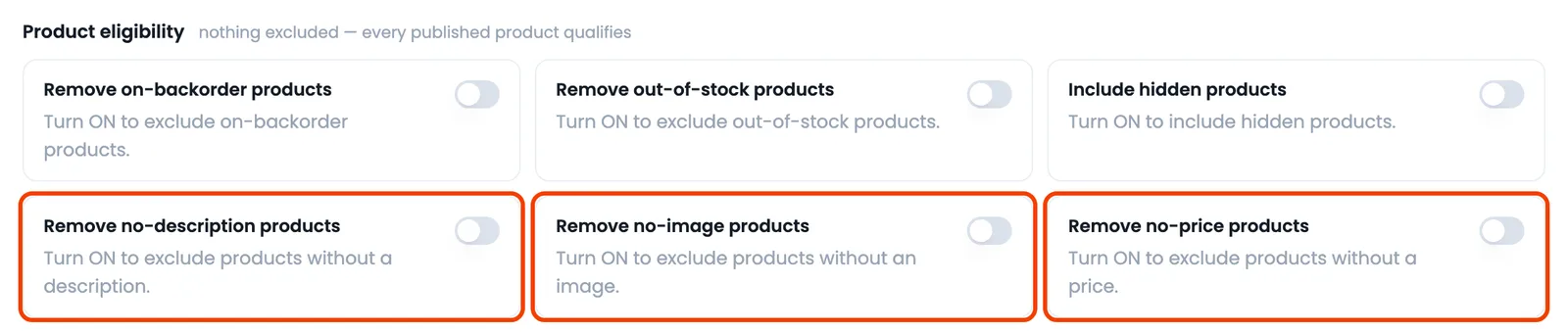
Steps: Remove product if description, price or image is empty (Pro).
How to Identify the Right Keywords for Your Google Shopping Product Descriptions
The right keywords are the facts a buyer filters on. Google’s own best-practice list names them: size, material, intended age range, special features, technical specifications, shape, pattern, texture, design and variants. Write those facts in plain words and you’ve covered the keywords. Good WooCommerce SEO on the product page follows the same rule.
Start by thinking like a buyer: what would you need to know before ordering this, without seeing it?
1. Utilizing Product Type and Variations
Name the kind of product early: “hiking backpack”, not just “backpack”. It tells the shopper at once what the product is for, and it’s the phrase they type. Then mention the variant details that matter: capacity, colour, size.
“Product type” here means the words in your text. Google’s product_type attribute is a separate field for your own categories; see how product groups use product_type.
2. Material Composition and Texture
Material and texture are both on Google’s list. Say “100% cotton”, “full-grain leather” or “brushed stainless steel”. Shoppers who only buy cotton jackets look for that word, and it tells them about quality and care before they click.
3. Applying Size and Dimension Information
Size is on Google’s list. Give it in the units your buyers use: dimensions, capacity, clothing size, so buyers can check fit before they order. Shoppers often search by size too (“medium t-shirt”, “65-litre backpack”), so state it plainly.
4. Make Use of Brand Identity
Name the product’s brand when it describes the product: “Merino hiking socks by [your brand]”. Brand-loyal shoppers search for it. Also send it in the brand attribute, which Google requires for most new products.
Don’t confuse this with your store. Google bans your company’s name as promotional text in the description. The brand of the product is a product fact; “Buy from ExampleShop, the trusted outdoor store” is promotion.
Selling your own brands? See these WooCommerce brand plugins for showing the brand on your product pages.
5. Use Special Features and Functions
Special features are on Google’s list, and they’re often what separates your product from the next one: waterproof zips, a lifetime-sharp blade, USB-C charging. A shopper searching for that one feature will look for it in your text. Name each one plainly.
6. Targeted Age Group
If the product is for a specific age, say so: “for toddlers aged 2–3”, “balance bike for ages 3–5”. Google lists intended age range as a detail to include. Apparel also has a separate age_group attribute, which Google requires in some countries.
7. Shape
Shape helps shoppers picture the product and how it fits a space: “round”, “L-shaped”, “oval”. It matters most for furniture, mirrors, rugs and accessories. Google lists shape, pattern and design among the details to include.
How to Optimize Google Shopping Description: 6 Ways
Meeting the rules keeps you out of trouble. These six habits make the description useful. For the rest of the feed, see Google Shopping feed optimization.
1. Important Details First
Google’s advice: list the most important details in the first 160–500 characters, because shoppers need to click to see the rest. That’s your space for what the product is, the key spec and the variant. For example (illustrative): “Merino wool hiking socks with a cushioned sole and reinforced heel. Size M (EU 39–42), charcoal grey, pack of 2.” Those first words already say what it is, what it’s made of, the size and the variant. Use the other characters, up to 5,000, for the details a buyer checks next.
2. Think Like a Buyer; Write for a Customer
Before you write, ask what a buyer needs to know to order this without seeing it. Then answer those questions in plain, professional language. Describe what the product does for them, not how great your store is.
3. Using Accurate and Specific Information
Be specific and accurate. “Water-resistant to 5 ATM” beats “great for swimming”. Give the material, the technical specs and the function, and leave out filler. Everything you write must also match the landing page.
4. Adding Special Features
Say a shopper wants a backpack with a water-resistant shell and a padded laptop sleeve. If your description names both, it answers their search directly. List the features that set the product apart, each in a few words. (See Special Features above for what to include, and our conversion-rate guide for the rest of the listing.)
5. Keywords Placement
Put the words a buyer searches for, such as product type, brand, size and material, near the start, where they also count as “important details first”. Then use them naturally. One clear mention beats five repeats.
6. Avoid These Mistakes in Your Product Descriptions
No all caps, comparisons, promotional text, links or category paths. Each is in the requirements table above and in Common Mistakes below.
5 Key Benefits of Using Google Shopping Descriptions Properly
What a good description does for you, in our view:
1. Improved Search Visibility
The facts in your description give Google more to match against what shoppers search for. More on that in how to rank higher on Google Shopping.
2. Better User Experience
Shoppers get the facts they need before they click, so fewer of them are surprised by what arrives.
3. Increased Conversions
A shopper who already knows the size, material and key feature arrives at your page closer to a decision.
4. Competitive Advantage
When listings look alike, the one that answers the buyer’s question in the first lines is easier to choose.
5. SEO Benefits
The same clear, specific text helps your product page too.
5 Common Mistakes With the Google Shopping Product Description Attribute
Five mistakes to avoid. If you’re already seeing errors, see common Google Merchant Center errors.
1. Using Different Kinds of Promotional Texts
“Free shipping”, “20% off” and “order today for delivery by Friday” feel like they’d sell more. Google’s rule says they don’t belong: price, sale dates, shipping, delivery dates and your company name are all promotional text. Put them in their own attributes.
2. Keyword Stuffing
Repeating “hiking backpack hiking bag hiking rucksack” doesn’t add information. It makes the text hard to read and breaks Google’s ask for professional, grammatical language. Use each keyword once, where it fits.
3. Thinking Short Product Description Is a Problem
A short description is fine if it’s complete. Google’s minimum is 1 character and the maximum 5,000; there’s no length you have to reach. The goal is accurate and specific, with the key facts in the first 160–500 characters. Padding a short description with vague text makes it worse, not better.
4. Using Other Attribute Information in the Description
Price, availability and the product URL each have their own attribute. Category paths don’t belong either. Put each fact where Google expects it:
pricefor the price;availabilityfor stock status;linkfor the product URL;google_product_categoryfor Google’s category;product_typefor your own category;descriptionfor product details only.
5. Putting AI Text in description
Google requires descriptions written by generative AI to go in structured_description with digital_source_type set to trained_algorithmic_media. If you send both attributes, only description is used, so adding a structured copy doesn’t fix it. See AI-written descriptions.
FAQs About Google Shopping Description Attribute
What is the Google Shopping description attribute?
It’s the description field in your product feed. It tells shoppers and Google what the product is, with details such as material, size and features that don’t fit in the title. Google requires a description for every product, in description or structured_description.
Is the description attribute required in Google Merchant Center?
Yes. Every product needs a description or a structured_description. Google says a product without one receives a warning and may experience limited performance.
What is the Google Shopping product description character limit?
1 to 5,000 characters. If it’s longer, Google truncates it and shows a warning.
How long should a Google Shopping product description be?
As long as it takes to be specific, within 1–5,000 characters. Google’s guidance is to put the most important details in the first 160–500 characters, because shoppers have to click to see the rest.
Can I add free shipping in the Google Shopping description?
No. Google counts shipping as promotional text, along with price, sale price, sale dates, delivery dates and your company name. Set shipping in Merchant Center or in the feed’s shipping attributes instead.
What should a Google Shopping description include?
The product’s most relevant features: size, material, intended age range, special features, technical specifications, shape, pattern, texture, design and variants. Put the key ones first.
What should I avoid in a Google Shopping product description?
Promotional text (price, shipping, sale dates, your company name), links, comparisons with other products, category paths, all caps and symbols, and details about other products or your business policies.
What is the difference between description and title in Google Shopping?
The title is the product’s name. The description adds the details that don’t fit in the title. Both must be consistent with each other and with the landing page. For titles, see Google Shopping title optimization.
What is the difference between description and product_type?
description is text about the product for shoppers. product_type is an optional attribute for your own category path, such as “Home > Women > Dresses”, up to 750 characters with > between levels. CTX Feed fills it from your WooCommerce category path by default. More in product groups in Google Shopping.
What is the difference between description and google_product_category?
description explains the product. google_product_category is an optional attribute for the category from Google’s own taxonomy. Don’t put either kind of category path in the description. See the Google product category guide.
Can I use keywords in Google Shopping descriptions?
Yes, as long as they’re natural, accurate product facts. Google’s best-practice list (size, material, features, specs) is effectively your keyword list. Don’t repeat words to rank; it breaks the ask for professional language.
Can I use AI to write Google Shopping descriptions?
Yes, but Google requires AI-generated descriptions to be sent as structured_description, with digital_source_type set to trained_algorithmic_media. If you send both, only description is used.
Can I use HTML in a Google Shopping description?
Google’s description page doesn’t cover HTML, and its product data specification gives the description’s syntax as plain text. So send plain text. In CTX Feed, the default Product Description value has HTML tags and shortcodes removed.
Final Checklist Before Submitting Your Google Shopping Feed Description
Before submitting your product feed to Google Merchant Center, check:
- Does the description clearly explain the product?
- Does it name the kind of product early?
- Does it give the material, size, colour or key feature details?
- Are the key details in the first 160–500 characters?
- Does it avoid promotional text, links and comparisons?
- Does it match the product title and the landing page?
- Does it avoid keyword stuffing?
- Are price, availability, link and category in their own attributes?
- If the text was written by AI, is it in
structured_descriptionwithtrained_algorithmic_media? - Are HTML tags and shortcodes removed from the feed?
If every answer is yes, your description is ready. For more on the whole feed, see our WooCommerce Google Shopping guide.
Promo text breaks Google’s description rules, a missing description gets a warning, and raw HTML or shortcodes don’t belong in a plain-text field. CTX Feed sends a clean, plain-text description from every WooCommerce product, and variations without their own description inherit the parent’s. CTX Feed Pro adds commands to trim, clean and cap the text, and can drop products that still have no description.

Free version on WordPress.org. Every Pro licence includes a 30-day money-back guarantee.